aletheic environments

biophilic environments that awaken your senses

Tag: humanism

  • Really noticing

    Really noticing

    In this post, I reflect on my frequent visits to nearby woodlands, particularly from spring to summer. I have made the effort to intentionally notice the way the woodland changes with the seasons, as well as how I experience it. The unseasonal heatwave intensifies the sensory experience of the forest. The practice of forest bathing enhances my appreciation of nature, highlighting humanity’s connection to the environment.

    Note: This post explores the psychological and wellbeing benefits of nudity and naturism within natural environments. It contains illustrations depicting nudity and the human form.

    There are some nice woodlands close to where I live. I visit them several times a week – especially in the spring and summer – for walks and to engage in forest bathing. I have been to this patch of woodland several times since the middle of April this year and have made the effort to notice the transition from spring to summer.

    Photograph of bluebells and wild garlic on a woodland floor in early April

    There was a profusion of bluebells on the woodland floor in the spring…

    Photograph of woodland in late may

    … then the gradual growth of foliage in the shrub layer followed by the development of a dense canopy in early summer.

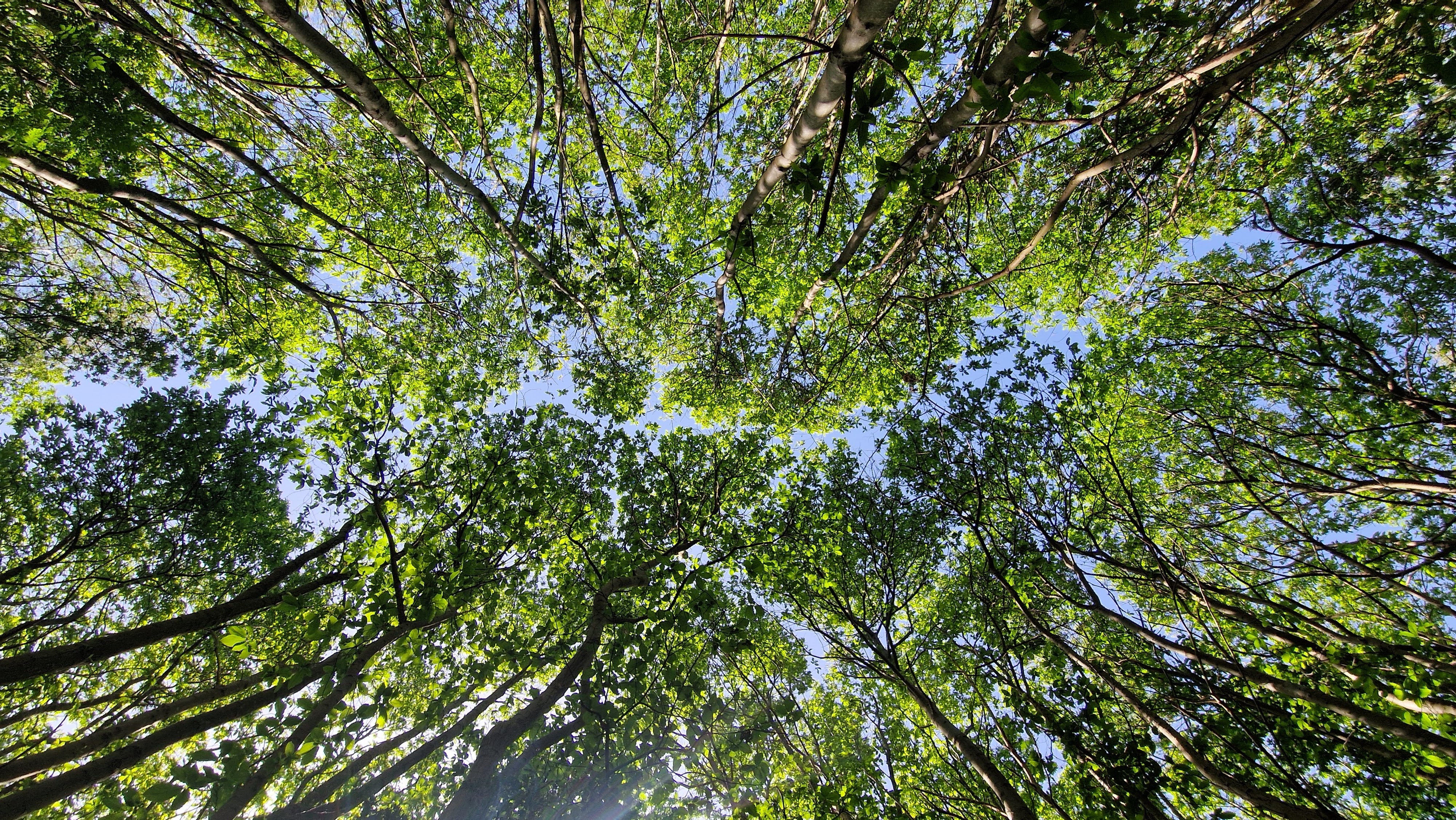
    View of the tree canopy in a woodland, showing how individual trees maintain their own place and avoid shading each other

    Over the last two or three weeks, the sounds of birdsong have been more intense and noticeable. Rabbits and squirrels are more common, molehills are appearing and woodland species of butterflies are making an appearance. Yesterday, I saw a woodpecker.

    I noticed some other things too.

    At the time of writing (24 June, 2026), here in Southern England, we are experiencing an unseasonal heatwave with record-breaking temperatures being predicted. In the early hours of yesterday morning, there were intense thunderstorms and heavy downpours. The woodland floor was damp and the air was still and humid.

    Woodland following intense thunderstorms and heavy rain in late June

    The first thing I noticed was the smell. They were so much more intense than normal. Sweet floral notes and earthy, mossy, fungal vegetal odours combined in ways that were surprising.

    The way my skin felt was very different. The warm, still, humid air felt as if it was enveloping me. Just about every one of my senses was awakened and seemed more sensitive.

    The contrast between yesterday and three days before was remarkable.

    That contrast in experience may be because I have been making an effort to notice my environment more – something that is an essential component of the practice of forest bathing. It is almost certainly amplified by being able to experience a totally immersive sensory experience by being naked. I am sure that the changes in the way the air felt wouldn’t have been as obvious were my skin to be covered.

    Photograph of a nude male figure, facing away from the camera, standing in a woodland environment in mid-June in Southern England

    Aletheia is all about experiencing the truth of the environment and our unconcealed place in it. This purposeful noticing of the environment, rather than the passive acceptance of our place in it really makes a difference to my appreciation of nature, our vulnerability in its majesty, but also the way that nature changes over time.

    I am not a religious person, and I have written before about my humanist outlook. However, immersion in natural places explains why so many religions are rooted in respect and worship of nature – human survival is deeply entwined with the survival of our natural environment.

  • Really knowing our place in nature: from a humanist’s point of view

    Really knowing our place in nature: from a humanist’s point of view

    This article further explores the concepts of risk, peril, and awe within biophilic design, highlighting their psychological significance. I argue that these feelings reveal truths about our existence and relationship to nature, encouraging humility and recognition of our transience as humans. Ultimately, it suggests that experiencing awe fosters a deeper connection with the environment.

    Note: This post explores the psychological and wellbeing benefits of naturism within biophilic environments. It contains illustrations depicting nudity and the human form.

    Experience awe for a deeper connection to nature

    I have previously written about risk, peril and awe. These are regarded as patterns of biophilia that are only just being developed as elements of biophilic design.

    • Risk / peril is thought of as a feeling of an unidentifiable threat. The biophilic solution leads to the knowledge that a reliable safeguard exists.
    • Awe relates to the stimuli that defy an existing frame of reference and which leads to a change in perception.

    These two patterns can be the ones that can be most revealing of themselves and of ourselves. This is the bridge between biophilia and aletheia.

    The patterns of risk / peril and awe are deeply rooted in our innate psychological and biological responses.

    Aletheia is all about revealing the truth about oneself and the environments we use, so when a space where truth and unconcealedness are central, the experience becomes about confronting reality directly and authentically – and almost reverentially.

    Awe and reverence

    I am not remotely religious or spiritual. I am a humanist and am content in my belief that we have only one life. I try to make sense of the world through logic, reason, and evidence, and always seek to treat those around me with warmth, understanding, and respect. I don’t believe that there was a divine creator – I think we are the products of nature, evolution and happenstance.

    That doesn’t mean that I don’t look on the world without a sense of awe. I do. I also respect and even revere nature and I am sympathetic to the concept of Gaia as expounded by James Lovelock – not as a superorganism, but as a metaphor for a self-regulating system of living and non-living processes.

    Photograph of the canopy of a forest showing how a population of trees self-regulate the growth of their canopies.  Image by the author
    A forest canopy in Southern England. Image by the author

    Nature is full of places that are jaw-droppingly astonishing and awesome in the true sense of the word. Humanity has created spaces with the specific aim of eliciting an emotional response – often religious (or at least worshipful), all the way back to the stone age.

    Humanity has also created great art and music that inspires awe and reverence that can trigger profound emotional responses.

    Photograph of Stone Henge, Wiltshire, England.  A stone-age monument aligned with the sunrise on the summer solstice
    Photo by Florian Gerus on Pexels.com

    Awe is an emotion that can make one recognise vulnerability and help reveal the truth of our place in the grandness of nature and the vastness of time and space.

    This is a healthy reaction. It helps us to recognise our personal vulnerability and also our need to be connected to the environment for our individual and collective survival.

    As Carl Sagan reminds us, the Pale Blue Dot in space that is Earth is all that we have.

    We are transient

    If we are lucky, we will spend 80-odd years alive – about 0.03% of the amount of time modern humans have existed. That is not even a flicker in the 4.5 billion years that the Earth has been around.

    It probably does us some good to experience awe as well as the feeling of humbleness as we reflect on our transience and in our position as just one of over eight billion humans alive today, and the countless billions who will ever have lived.

    Strip away the artificial social armour of clothing and stand naked, alone in nature to get a real sense of the truth of our place in the universe.

    Unhidden, unconcealed, unprotected. This is the reality of our existence – even for those of us fortunate to live comfortably.

    Image depicting a hillside at night (scene is ai-generated) incorporating a photograph of nude male figure standing on the top of the hill looking up at the night sky