

The post discusses the benefits of biophilic design in home offices and other remote working environments. I explore whether performance, effectiveness and job satisfaction can be improved when the body is relaxed and the mind in a state of flow. I mention my personal experiences with naturism and, and advocate for comfort and sensory coherence in workspace design. I also suggest potential revenue opportunities for naturist venues.
Note: This post explores the psychological and wellbeing benefits of naturism within biophilic environments. It contains illustrations depicting nudity and the human form.
A different way of working from home
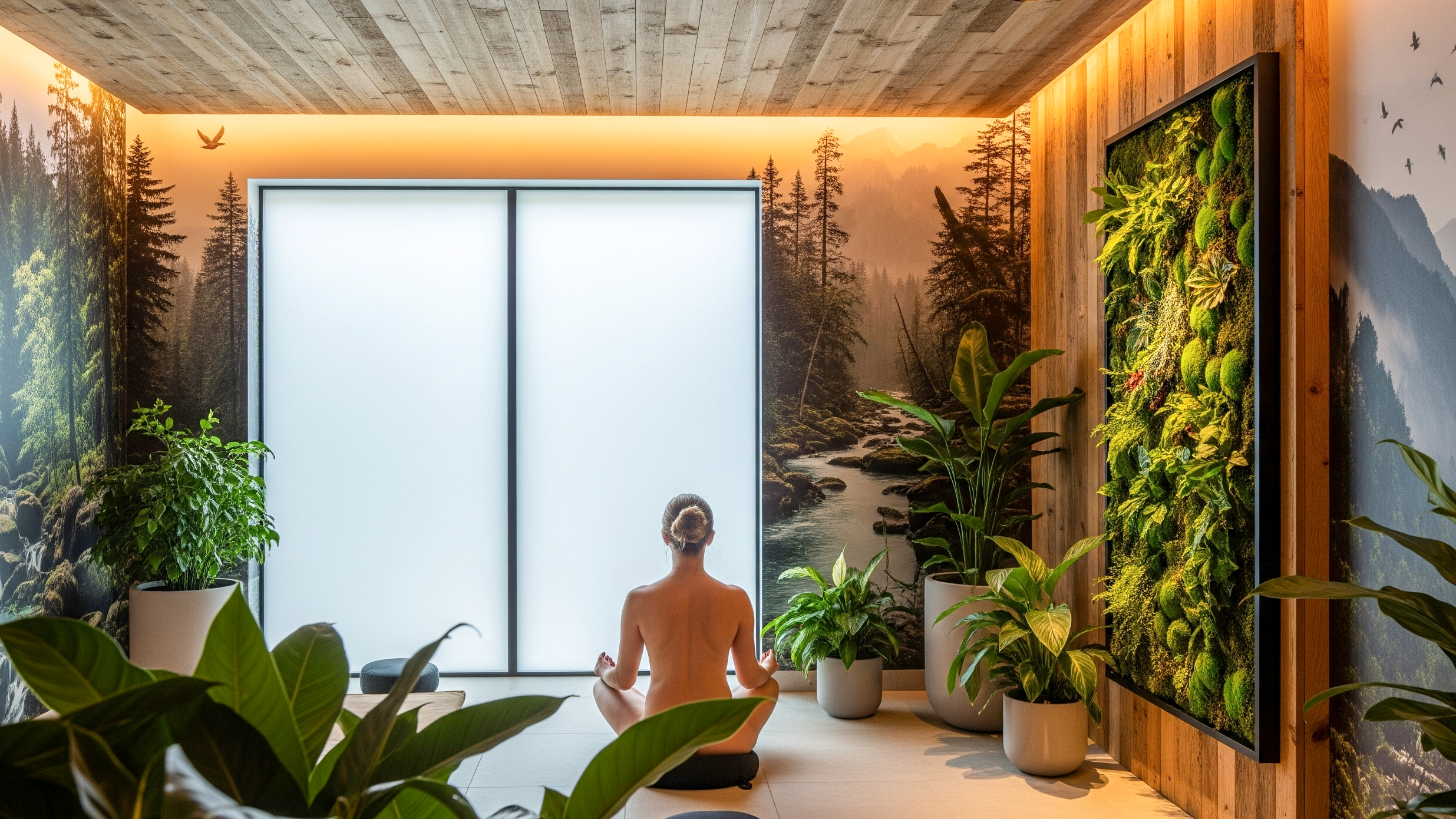
In a recent post, I wrote about creating spaces for meditation, especially naked meditation. It is a practice that gives an opportunity to notice one’s feelings and a place in the environment in a pure, unconcealed form.
That purposeful activity can be good to aid relaxation, decompress and clear the mind. I often start my working day with some meditation. Sometimes I will take a break from the desk and meditate during the day as well.
I work from home, and have done for almost twenty years, so when the pandemic hit and lockdown was imposed, I found it easy to adapt. I had a garden office and, at the time, lived in house in the countryside. The only thing that really changed was that even more of my work was conducted online and visits to offices and customers stopped completely.

This was also the time that I started my own business and ceased to be an employee (although not necessarily in that order!)
It was also a period when I contemplated naturism as more than just the beach activity that I had previously enjoyed.
I’ll get back to that.
Flow
Flow is a state that, when you get into it, seems to allow you to work with great clarity and almost without effort. When you get into that state, time flies and work gets done. However, every distraction or interruption can take you out of the flow state, and it can take several minutes to get back into it.
In many offices, noise is a major distraction. In an open plan space, it is impossible not to tune in to conversations taking place nearby. This is probably an artefact of our evolution – if there is a threat (or opportunity), it’s a good idea to know about it quickly and act accordingly. However, the brain tunes in before realising that the conversation is only about someone cooking fish in the office microwave. At that point, flow has stopped and it takes a while to get going again. This is one reason why a lot of people wear headphones in the office – not just to take calls, but to block out inane chit-chat.
It’s not just noise. Flow can be disrupted by any distraction, and that distraction can be the result of getting confused sensory inputs. This is where biophilic design comes in.
Biophilic design for sensory coherence
A lot of people think that biophilic design is just putting plants in buildings. Plants are certainly a vital component, but biophilic design is really about creating spaces that allow all of our senses to work together in harmony. The things we see should be reinforced, not contradicted, by what we hear, touch, feel and smell. It is about creating built environments that evoke a feeling of nature that relates to our evolutionary history.
An organization called Terrapin Bright Green has been at the forefront of biophilic design thinking, and it has produced its famous and insightful publication about the 14 Patterns of Biophilic Design (to which a 15th category, Awe, has recently been added).

The fourteen patterns are grouped into three categories: nature IN the space, nature OF the space and natural analogues.
A truly biophilic workspace is a significantly better place to be compared with a more conventionally-designed office, and is probably more productive. Certainly, a lot of employers are investing a lot of money into workspaces that are more comfortable and aid wellbeing.
Home working
Many office workers (maybe even the majority in some countries) work from home at least some of the time, and the home office is rarely as expensively fitted out as the most modern office building. The home office may not be free from distractions. However, there are things that can be done to help get into a state of flow. Including a couple of things that can’t easily be done in an office.
A few years ago, I was involved with a research programme carried out at the University of Exeter, which demonstrated that the more autonomy and empowerment office workers had over their working environment (from furnishings to decoration, and even the positioning of pot plants), the more comfortable they were.
When they were more comfortable, they were happier, had greater job satisfaction and, ultimately, were more productive.
The home office is where autonomy over the working environment is almost complete.
Sensory coherence and connection with your environment are the key to success. A working space that provides a true, aletheic connection with nature can be very effective.
Let’s start with the basics.
Comfortable furniture and good lighting are priorities
Without those, then the chances of working comfortably, and productively are diminished. Lighting, in particular, is important and I would recommend investing in a good quality desk lamp as well as making the most of smart lighting and windows.
Next,
Temperature and ventilation need to be considered
Most homes don’t have air conditioning, so managing the indoor climate is under your own control. You have the power to turn on the heating, light a fire, open a window or use a fan as you wish.
Admittedly, the recent heatwaves here in England have made keeping cool quite difficult, but there are ways to make it bearable – especially if you can shift your working hours to the cooler parts of the day.
Working in a home office also means that clothes are much less important and can be worn (or not) for comfort rather than image and convention. Video calls, however, might require one to wear something more business-like.
Biophilic design in the home office
Once the basics of a home workspace are in place, we can look at some more biophilic elements. Here are a few tips.
Give yourself a view

If possible, arrange your desk so that when you look up from the keyboard or screen you can see out of a window. Even if the view is of another building, it will be something distant to focus on, and that will ease eye strain and bring give you a sense of what is going on outside – it might help you decide whether to venture out on a break, or hunker down in the warm, but whatever the weather, you will connect to the world outside.
Open a window
An open window will refresh the air and flush out excess carbon dioxide and other pollutants generated inside the home. It will also bring the sounds of the outside world in – you may hear voices or birdsong or the sound of the wind. It might also be traffic noise, but even that can sometimes be a relief from silence.
Buy some houseplants
This is the eye-catching, Instagram-friendly intervention that will illustrate the pages of the colour supplements and lifestyle websites. However, it is an effective way of bringing some life indoors.

Houseplants need not be expensive or huge. Ikea, for example, has some terrific plants and pots at very good prices (and I know a lot about indoor plants, so you can trust my judgement on this). They add green interest to the indoor environment and also demand some care. Watering (not too much), cleaning and trimming, and arranging plants can be very therapeutic.
Follow your nose
Our sense of smell is our most primitive – detecting chemicals in the environment (which is what the sense of smell is all about) was the first sense to evolve in the animal kingdom. We often react to scents instinctively and before we are consciously aware of them, so we can use fragrances to create a multi-dimensional sensory environment very easily. The range and quality of home fragrances is more comprehensive than ever before, so there is bound to be something appealing.

I’m not going to go down the road of recommending particular scents for particular settings or tasks – we risk straying into pseudoscience – just choose something that you, and your housemates, like.
Water
We use our sense of hearing and smell to detect the presence of water, often before we see it – this is a survival mechanism. As wild animals, we needed to be able to find safe water – not just to drink, but to find prey that also needed a drink.
The sound of rainfall or babbling streams can be found easily just by asking Alexa (or other smart speaker system). A fish tank or small indoor water feature can also be soothing.
Take care of your skin
The skin is your largest sense organ. As well as stopping your insides from escaping, your skin is home to sensors that detect temperature, pressure, movement and resistance, shape and texture. It even senses changes in humidity and static electricity.
Don’t starve it of sensation. Use different textures around your workstation and allow your skin to be stimulated – maybe all of it, not just the hands and face. Someone once suggested to me that clothes on skin were akin to a blindfold for the eyes.
Create a breeze (not a draught), experience some sunlight or even take a shower for pleasure rather than utility.
Comfort is the key
Biophilic design isn’t just about plants. It isn’t about bringing nature indoors. It is about being comfortable – physically and mentally. Comfort brings happiness and happiness is the key to both life satisfaction and also job satisfaction. A little investment in comfort can pay huge dividends for the individual and employers relying on home-based workers.
Non-rhythmic sensations: shadows and sounds
Nature is pretty random. The sites and sounds of nature are rarely regular. Think of the sounds made by wind or rainfall, the rustling of leaves or the play of shadows across the ground. These non-rhythmic stimuli can be replicated in the home too: flames in fireplace or candle, the sounds of rainfall (as mentioned earlier) or even the impact of water droplets on the skin from a shower can be comforting and calming.

Working naked
I mentioned earlier that during the Covid lockdowns of 2020 my exploration of naturism shifted. Before then, I occasionally visited naturist beaches, often on holiday, because it felt comfortable and liberating. Swimwear seemed pointless and nude swimming was a revelation.
However, during lockdown, with access to a secluded garden and with time on my hands, I started to think more deeply about naturism, its philosophy (or philosophies – there are as many as there are naturists) and the reasons for it feeling so good.
I took to spending time in the garden naked, which was wonderful. The complete, uncovered connection with my environment revealed more about me than just my body. Something deeper stirred.
Then I experimented with not getting dressed for work unless I had a video call. I don’t think I was alone in that. If anecdotes on social media are anything to go by, lots of people experimented with naked working.
Mental clarity
My own experience (and this may not be everyone’s) was one of clarity. I could enter a flow state more quickly, think more clearly and get more stuff done. This may be coincidence, but it may also be as a result of the holistic, coherent sensory environment that I had created. My home office was already pretty biophilic, but now it was not just the stuff in the office, it was the interaction between my environment and my whole self that seemed to work.
These days, unless it is very cold, or if I have to take part in video calls, I will probably be naked when working in my home office.
Try it for yourself – you have nothing to lose, and you might find that you work better as a result.

Get in touch if you would like some advice on how to design your own aletheic home office – there’s a contact form at the end of this post.
Opportunities for naturist-friendly venues
I cannot foresee a time (certainly in my remaining lifetime) that companies will create nude working zones in their office buildings. It is true that wellbeing and biophilia are informing design choices in offices, but enabling naturist work is unlikely to take off. There may be some opportunities to use the plethora of wellness rooms that are appearing in office buildings, but I don’t see it happening as a mainstream way of working.
Remote workers and freelancers often find themselves working from coffee shops, coworking spaces or even motorway services. These are not always ideal places to work, and are often noisy, distracting and very far from being biophilic. However, there may be some spaces that could be used.
According to a recent survey highlighted by British Naturism, over 6 million people in the UK have taken part in naturist activities. A lot of those people will be office workers. Some of those office workers may well rely on remote locations for some of their work.
I think there is an opportunity for naturist clubs to take advantage of this potential market. There is an opportunity to open up a new revenue stream and make some extra income during the winter months, or during periods of bad weather when traditional naturist activities are limited.

Many clubs have pavilions or club houses. With a few biophilic interventions, maybe an upgrade to their internet connections and some desks and office chairs, they could set themselves up as co-working spaces for those that would like the opportunity to work unconfined by clothing.
Access could be given to members of British Naturism, or a network of venues could set up a membership scheme (subject to the usual vetting processes) and users could join a subscription scheme or just pay as they used a space.
I have a background in workplace wellbeing, biophilic design and horticulture. I work with architects and designers, and others, in the creation of effective working environments.
If you run a naturist venue and think that this is an idea worth looking into, get in touch. I would be happy to have a chat about it with you, and maybe even visit your location see what might be possible.




Leave a Reply