Real biophilic design – for humans, not spreadsheets.
An aletheic environment is a space intentionally designed for unconcealment – stripping away the artificial to create an authentic, unfiltered connection between people and the natural world.
My aim is to create environments that recognise and honour the human body as a natural component of its habitat – not merely an observer – to foster happiness, health, and authenticity.
The blog: Thoughts about biophilic design, wellbeing, and our place in nature
In this post, I explore some of the patterns of biophilic design: categorized into nature interactions, spatial qualities, and the psychological impact of environments. The feelings of risk, peril, and awe highlight how these elements could enhance experience in authentic spaces.
Note: This post explores the psychological and wellbeing benefits of naturism within biophilic environments. It contains illustrations depicting nudity and the human form.
In my last post, I mentioned the work by Terrapin Bright Green about the patterns of biophilia and how they can be incorporated into the built environment. The patterns are grouped into three categories
Nature in the space
This is, essentially, the stuff you put in, on and around a building to evoke a sense of being in nature
Visual connection with nature (e.g. plants and greenery)
Non-visual connection with nature (e.g. scents and soundscapes)
Non-rhythmic connections with nature
Thermal and airflow variability
Presence of water
Dynamic and diffuse light
Connection with natural systems
Natural analogues
This relates to materials and nature-inspired design
Biomorphic forms and patterns
Material connections with nature
Complexity and order
Nature of the space
This is the area I find most fascinating, as it relates not just to what is used, but how the space is used and how we feel in the space.
Prospect: views over a distance
Refuge: a place for withdrawal where there is safety, privacy and room to contemplate
Mystery: encouragement to travel deeper into the environment
Risk / peril: an unidentifiable threat coupled with the knowledge of a reliable safeguard
Awe: stimuli that defy an existing frame of reference and lead to a change in perception
I think that the last two patterns can be the ones that can be most revealing of themselves and of ourselves. This is the bridge between biophilia and aletheia.
The patterns of risk / peril and awe are deeply rooted in our innate psychological and biological responses. When applied to an aletheic environment – a space where truth, non-concealment and unconcealedness are central – the experience becomes about confronting reality directly and authentically.
Experiencing risk and peril in an aletheic environment
Risk and peril is about feeling an identifiable threat coupled with a sense of security. In a true, unconcealed space, this isn’t about physical danger but about psychological and social vulnerability.
The peril is the risk of being seen, judged, and fully exposed, not physically but in a raw, authentic state. The safeguard is the trust and acceptance of the environment and the people within it. This creates a sense of profound psychological safety.
As a sensory experience, the peril could be the feeling of being fully exposed to the elements, such as the cold touch of stone, an unexpected breeze, being caught in a shower of rain or the warmth of the sun on the skin. This is a direct, unmediated sensory feedback which leads to an authentic, unconcealed experience of the environment.
When we consider the design of a space, we might think about spaces with a high, open ceiling (prospect) that also has small, intimate nooks (refuge). The “risk” is the exposure of the open area, while the “safety” is the option to retreat. The design itself mirrors the push and pull of vulnerability and security.
Experiencing awe in an aletheic environment
Awe, as a pattern, is about confronting something vast and complex that challenges our existing understanding. In an aletheic context, awe comes from a sense of truth and connection.
In nature, these environments could be vast forests, open plains, high waterfalls of sheer cliff faces. Places where we really can recognise our vulnerability against such scale and natural power, but also knowing that, as a species, we have been able to navigate, and even thrive, in such environments.
Sometimes, we can also create such spaces. Places like the Great Pyramids, Stonehenge, vast cathedrals and temples all evoke a sense of awe. More modern spaces such as the magnificent palm house at Kew Gardens, the Eden Project in Cornwall or even places such as Bangalore Airport can make one gasp.
Imagine a large indoor waterfall, a living wall that extends through multiple floors, or a glass ceiling that reveals the night sky. These elements present a complex, vast system that you can directly experience, connecting you to something bigger than yourself.
Unconcealed Design
Awe can also come from the honesty of the materials and structure. Exposed building materials like raw concrete, untreated wood, or a direct view of a building’s mechanical systems can be awe-inspiring in their authenticity and lack of artifice.
Lloyds of London building. Photo by Kei Scampa on Pexels.com
The complexity and beauty of biomorphic forms can also inspire awe. A large, spiral staircase mimicking a seashell or a structure with branching columns like a tree can create a sense of wonder and connection to the vast patterns of life.
Interior of Changi Airport, Singapore. Photo by Lynde on Pexels.com
Raw exposure: nudity amplifies the experience
Nudity in these spaces doesn’t just add to the experience; it can fundamentally change it, making the sensations of risk, peril, and awe more intense and immediate. It is easier to achieve in a natural environment, but could be possible in the built environment – perhaps through out-of-hours naturist tours of places like a grand botanic garden or architectural masterpiece.
Being unclothed removes a primary layer of social protection and concealment. It makes the risk of being seen more palpable and immediate, which in turn makes the safety of the trusting environment even more profound. The body’s immediate vulnerability to temperature changes and textures also heightens the sensory peril and the confidence in a safeguard.
Nudity creates a direct and unmediated experience. Being naked removes the physical and psychological barrier between the person and the environment. You are not just observing the space, you are directly interacting with it through your whole body. This unmediated connection enhances the feeling of aletheia, as there is no concealment between you and the truth of the space.
The experience of awe becomes embodied. Instead of just a mental concept, you feel the smallness of your body in a vast space or the intricate complexity of a natural pattern against your skin. This can lead to a deeper, more visceral sense of wonder and connection to the world around you.
The integration of nudity in an aletheic, biophilic space is not just about personal preference but about a deeper philosophical alignment with the patterns themselves, a move towards total non-concealment and an authentic experience of the world.
The post discusses the benefits of biophilic design in home offices and other remote working environments. I explore whether performance, effectiveness and job satisfaction can be improved when the body is relaxed and the mind in a state of flow. I mention my personal experiences with naturism and, and advocate for comfort and sensory coherence in workspace design. I also suggest potential revenue opportunities for naturist venues.
Note: This post explores the psychological and wellbeing benefits of naturism within biophilic environments. It contains illustrations depicting nudity and the human form.
A different way of working from home
In a recent post, I wrote about creating spaces for meditation, especially naked meditation. It is a practice that gives an opportunity to notice one’s feelings and a place in the environment in a pure, unconcealed form.
That purposeful activity can be good to aid relaxation, decompress and clear the mind. I often start my working day with some meditation. Sometimes I will take a break from the desk and meditate during the day as well.
I work from home, and have done for almost twenty years, so when the pandemic hit and lockdown was imposed, I found it easy to adapt. I had a garden office and, at the time, lived in house in the countryside. The only thing that really changed was that even more of my work was conducted online and visits to offices and customers stopped completely.
Garden office in winter
This was also the time that I started my own business and ceased to be an employee (although not necessarily in that order!)
It was also a period when I contemplated naturism as more than just the beach activity that I had previously enjoyed.
I’ll get back to that.
Flow
Flow is a state that, when you get into it, seems to allow you to work with great clarity and almost without effort. When you get into that state, time flies and work gets done. However, every distraction or interruption can take you out of the flow state, and it can take several minutes to get back into it.
In many offices, noise is a major distraction. In an open plan space, it is impossible not to tune in to conversations taking place nearby. This is probably an artefact of our evolution – if there is a threat (or opportunity), it’s a good idea to know about it quickly and act accordingly. However, the brain tunes in before realising that the conversation is only about someone cooking fish in the office microwave. At that point, flow has stopped and it takes a while to get going again. This is one reason why a lot of people wear headphones in the office – not just to take calls, but to block out inane chit-chat.
It’s not just noise. Flow can be disrupted by any distraction, and that distraction can be the result of getting confused sensory inputs. This is where biophilic design comes in.
Biophilic design for sensory coherence
A lot of people think that biophilic design is just putting plants in buildings. Plants are certainly a vital component, but biophilic design is really about creating spaces that allow all of our senses to work together in harmony. The things we see should be reinforced, not contradicted, by what we hear, touch, feel and smell. It is about creating built environments that evoke a feeling of nature that relates to our evolutionary history.
An organization called Terrapin Bright Green has been at the forefront of biophilic design thinking, and it has produced its famous and insightful publication about the 14 Patterns of Biophilic Design (to which a 15th category, Awe, has recently been added).
The fourteen patterns are grouped into three categories: nature IN the space, nature OF the space and natural analogues.
A truly biophilic workspace is a significantly better place to be compared with a more conventionally-designed office, and is probably more productive. Certainly, a lot of employers are investing a lot of money into workspaces that are more comfortable and aid wellbeing.
Home working
Many office workers (maybe even the majority in some countries) work from home at least some of the time, and the home office is rarely as expensively fitted out as the most modern office building. The home office may not be free from distractions. However, there are things that can be done to help get into a state of flow. Including a couple of things that can’t easily be done in an office.
A few years ago, I was involved with a research programme carried out at the University of Exeter, which demonstrated that the more autonomy and empowerment office workers had over their working environment (from furnishings to decoration, and even the positioning of pot plants), the more comfortable they were.
When they were more comfortable, they were happier, had greater job satisfaction and, ultimately, were more productive.
The home office is where autonomy over the working environment is almost complete.
Sensory coherence and connection with your environment are the key to success. A working space that provides a true, aletheic connection with nature can be very effective.
Let’s start with the basics.
Comfortable furniture and good lighting are priorities
Without those, then the chances of working comfortably, and productively are diminished. Lighting, in particular, is important and I would recommend investing in a good quality desk lamp as well as making the most of smart lighting and windows.
Next,
Temperature and ventilation need to be considered
Most homes don’t have air conditioning, so managing the indoor climate is under your own control. You have the power to turn on the heating, light a fire, open a window or use a fan as you wish.
Admittedly, the recent heatwaves here in England have made keeping cool quite difficult, but there are ways to make it bearable – especially if you can shift your working hours to the cooler parts of the day.
Working in a home office also means that clothes are much less important and can be worn (or not) for comfort rather than image and convention. Video calls, however, might require one to wear something more business-like.
Biophilic design in the home office
Once the basics of a home workspace are in place, we can look at some more biophilic elements. Here are a few tips.
Give yourself a view
If possible, arrange your desk so that when you look up from the keyboard or screen you can see out of a window. Even if the view is of another building, it will be something distant to focus on, and that will ease eye strain and bring give you a sense of what is going on outside – it might help you decide whether to venture out on a break, or hunker down in the warm, but whatever the weather, you will connect to the world outside.
Open a window
An open window will refresh the air and flush out excess carbon dioxide and other pollutants generated inside the home. It will also bring the sounds of the outside world in – you may hear voices or birdsong or the sound of the wind. It might also be traffic noise, but even that can sometimes be a relief from silence.
Buy some houseplants
This is the eye-catching, Instagram-friendly intervention that will illustrate the pages of the colour supplements and lifestyle websites. However, it is an effective way of bringing some life indoors.
Houseplants need not be expensive or huge. Ikea, for example, has some terrific plants and pots at very good prices (and I know a lot about indoor plants, so you can trust my judgement on this). They add green interest to the indoor environment and also demand some care. Watering (not too much), cleaning and trimming, and arranging plants can be very therapeutic.
Follow your nose
Our sense of smell is our most primitive – detecting chemicals in the environment (which is what the sense of smell is all about) was the first sense to evolve in the animal kingdom. We often react to scents instinctively and before we are consciously aware of them, so we can use fragrances to create a multi-dimensional sensory environment very easily. The range and quality of home fragrances is more comprehensive than ever before, so there is bound to be something appealing.
I’m not going to go down the road of recommending particular scents for particular settings or tasks – we risk straying into pseudoscience – just choose something that you, and your housemates, like.
Water
We use our sense of hearing and smell to detect the presence of water, often before we see it – this is a survival mechanism. As wild animals, we needed to be able to find safe water – not just to drink, but to find prey that also needed a drink.
The sound of rainfall or babbling streams can be found easily just by asking Alexa (or other smart speaker system). A fish tank or small indoor water feature can also be soothing.
Take care of your skin
The skin is your largest sense organ. As well as stopping your insides from escaping, your skin is home to sensors that detect temperature, pressure, movement and resistance, shape and texture. It even senses changes in humidity and static electricity.
Don’t starve it of sensation. Use different textures around your workstation and allow your skin to be stimulated – maybe all of it, not just the hands and face. Someone once suggested to me that clothes on skin were akin to a blindfold for the eyes.
Create a breeze (not a draught), experience some sunlight or even take a shower for pleasure rather than utility.
Comfort is the key
Biophilic design isn’t just about plants. It isn’t about bringing nature indoors. It is about being comfortable – physically and mentally. Comfort brings happiness and happiness is the key to both life satisfaction and also job satisfaction. A little investment in comfort can pay huge dividends for the individual and employers relying on home-based workers.
Non-rhythmic sensations: shadows and sounds
Nature is pretty random. The sites and sounds of nature are rarely regular. Think of the sounds made by wind or rainfall, the rustling of leaves or the play of shadows across the ground. These non-rhythmic stimuli can be replicated in the home too: flames in fireplace or candle, the sounds of rainfall (as mentioned earlier) or even the impact of water droplets on the skin from a shower can be comforting and calming.
Working naked
I mentioned earlier that during the Covid lockdowns of 2020 my exploration of naturism shifted. Before then, I occasionally visited naturist beaches, often on holiday, because it felt comfortable and liberating. Swimwear seemed pointless and nude swimming was a revelation.
However, during lockdown, with access to a secluded garden and with time on my hands, I started to think more deeply about naturism, its philosophy (or philosophies – there are as many as there are naturists) and the reasons for it feeling so good.
I took to spending time in the garden naked, which was wonderful. The complete, uncovered connection with my environment revealed more about me than just my body. Something deeper stirred.
Then I experimented with not getting dressed for work unless I had a video call. I don’t think I was alone in that. If anecdotes on social media are anything to go by, lots of people experimented with naked working.
Mental clarity
My own experience (and this may not be everyone’s) was one of clarity. I could enter a flow state more quickly, think more clearly and get more stuff done. This may be coincidence, but it may also be as a result of the holistic, coherent sensory environment that I had created. My home office was already pretty biophilic, but now it was not just the stuff in the office, it was the interaction between my environment and my whole self that seemed to work.
These days, unless it is very cold, or if I have to take part in video calls, I will probably be naked when working in my home office.
Try it for yourself – you have nothing to lose, and you might find that you work better as a result.
Get in touch if you would like some advice on how to design your own aletheic home office – there’s a contact form at the end of this post.
Opportunities for naturist-friendly venues
I cannot foresee a time (certainly in my remaining lifetime) that companies will create nude working zones in their office buildings. It is true that wellbeing and biophilia are informing design choices in offices, but enabling naturist work is unlikely to take off. There may be some opportunities to use the plethora of wellness rooms that are appearing in office buildings, but I don’t see it happening as a mainstream way of working.
Remote workers and freelancers often find themselves working from coffee shops, coworking spaces or even motorway services. These are not always ideal places to work, and are often noisy, distracting and very far from being biophilic. However, there may be some spaces that could be used.
According to a recent survey highlighted by British Naturism, over 6 million people in the UK have taken part in naturist activities. A lot of those people will be office workers. Some of those office workers may well rely on remote locations for some of their work.
I think there is an opportunity for naturist clubs to take advantage of this potential market. There is an opportunity to open up a new revenue stream and make some extra income during the winter months, or during periods of bad weather when traditional naturist activities are limited.
Many clubs have pavilions or club houses. With a few biophilic interventions, maybe an upgrade to their internet connections and some desks and office chairs, they could set themselves up as co-working spaces for those that would like the opportunity to work unconfined by clothing.
Access could be given to members of British Naturism, or a network of venues could set up a membership scheme (subject to the usual vetting processes) and users could join a subscription scheme or just pay as they used a space.
If you run a naturist venue and think that this is an idea worth looking into, get in touch. I would be happy to have a chat about it with you, and maybe even visit your location see what might be possible.
Get in touch for advice about creating an aletheic home office or remote working environment
You may have noticed that I am currently writing this website anonymously. This might seem odd, as one of the points of the site is to discover possible business opportunities and collaborations. So, who am I? Should I reveal myself? Do the benefits outweigh the risks?
Note: This post explores the psychological and wellbeing benefits of naturism within biophilic environments. It contains illustrations depicting nudity and the human form.
You may have noticed that I am currently writing this website anonymously. This might seem odd, as one of the points of the site is to discover possible business opportunities and collaborations. So, who am I?
There is a good reason for my reticence
None of the people that I work with on a day-to-day basis are aware of my interest and participation in naturism. That may not be a problem for many people and (if recent surveys are anything to go by) there is a good chance that many colleagues and customers have taken part in, and may enjoy, naturist activities. Those that I have confided in have been very supportive and understand where I’m coming from.
However, a peculiarity of the interior landscaping and office fit-out industries in the UK is that a very significant proportion of the companies in those sectors (who make up much of my existing, and potential, client base in my day-to-day work) are companies owned by members of a very conservative religious group. I think that they would have great difficulty in understanding, let alone tolerating, the ideas that I’m trying to develop here.
Let me be clear. These companies are, generally, good employers and their business ethics are, mostly, pretty sound. They have modernised and know that they have to be more accepting of people from backgrounds different from theirs if they want to succeed in business.
I am also fairly sure that the bespoke web browsers that these companies use would block this site, so they would not find it (although those of their employees who are not part of the church might discover it on their private devices and report back).
However, I am pretty sure that some of the concepts behind creating aletheic spaces would be uncomfortable and probably too alien for them to consider working with me again.
Authenticity
You may think that I should be braver and also be authentic. After all, I believe that authenticity is a core tenet of naturism and aletheia is all about revealing the truth. Maybe I should.
Should I risk potential income from one segment of my potential market place to open up new opportunities? Do the benefits of being identifiable outweigh the risks?
Please leave a comment. Your thoughts would be very welcome.
Reflections on the ups and downs I experienced post-pandemic, and how meditation has helped my mental health. Through personal insights, I discuss finding peaceful spots for meditation, both outdoors and indoors, and suggest creating calming environments with natural elements. The potential benefits of nude meditation and the role of wellness spaces are also highlighted.
Note: This post explores the psychological and wellbeing benefits of naturism within biophilic environments. It contains illustrations depicting nudity and the human form.
A period of change
The last few years have had their ups and downs for me, and for many others as we emerged into our post-pandemic world of seemingly ever more uncertainty. New ways of working and the stresses of a high cost of living have taken their toll on mental health.
Now, I am not a therapist, and I don’t pretend to be able to offer advice, but I can say that taking fifteen to thirty minutes out of my day for meditation has done me the power of good.
I started with guided meditations (and there are some good sources available online), but now I tend to guide myself. The key is to really notice how you feel, and that includes how your body feels in relation to the space you are in.
It is possible to meditate almost anywhere, although quiet places are best. When distractions are minimized, and the place where you are meditating is calm, I think the process becomes more effective.
Connecting with nature
Connecting with nature makes a positive difference, as that reduces stress before you even start. Just being in a natural environment has been shown to reduce stress and improve wellbeing – even if only for as little as ten minutes a day. Find a quiet spot, notice how you feel and take time.
Having a literal connection with the Earth and the air can make the experience more profound. If you have access to a place where you can undress and experience nature in your most natural state, then you may uncover more than just your skin. For me, and I can speak only for myself, a state of nudity in nature when meditating reveals not only a connection with nature, but a realisation of our own place in nature.
Of course, finding such a place to go may be difficult. Not everyone is comfortable with the idea of being naked in a potentially public place (and in some countries, that may also be illegal, although thankfully not in the UK). So, what are the alternatives?
If you are lucky, you may have a quiet, secluded garden. Being able to step through your back door into your own private space is a luxury, but one that need not be expensive. Some simple screening with plants and the placement of items such as water features or a sculpture can help create a naturalistic feel and still allow a deep connection with nature. A patio or terrace can be put to good use too.
Indoor spaces
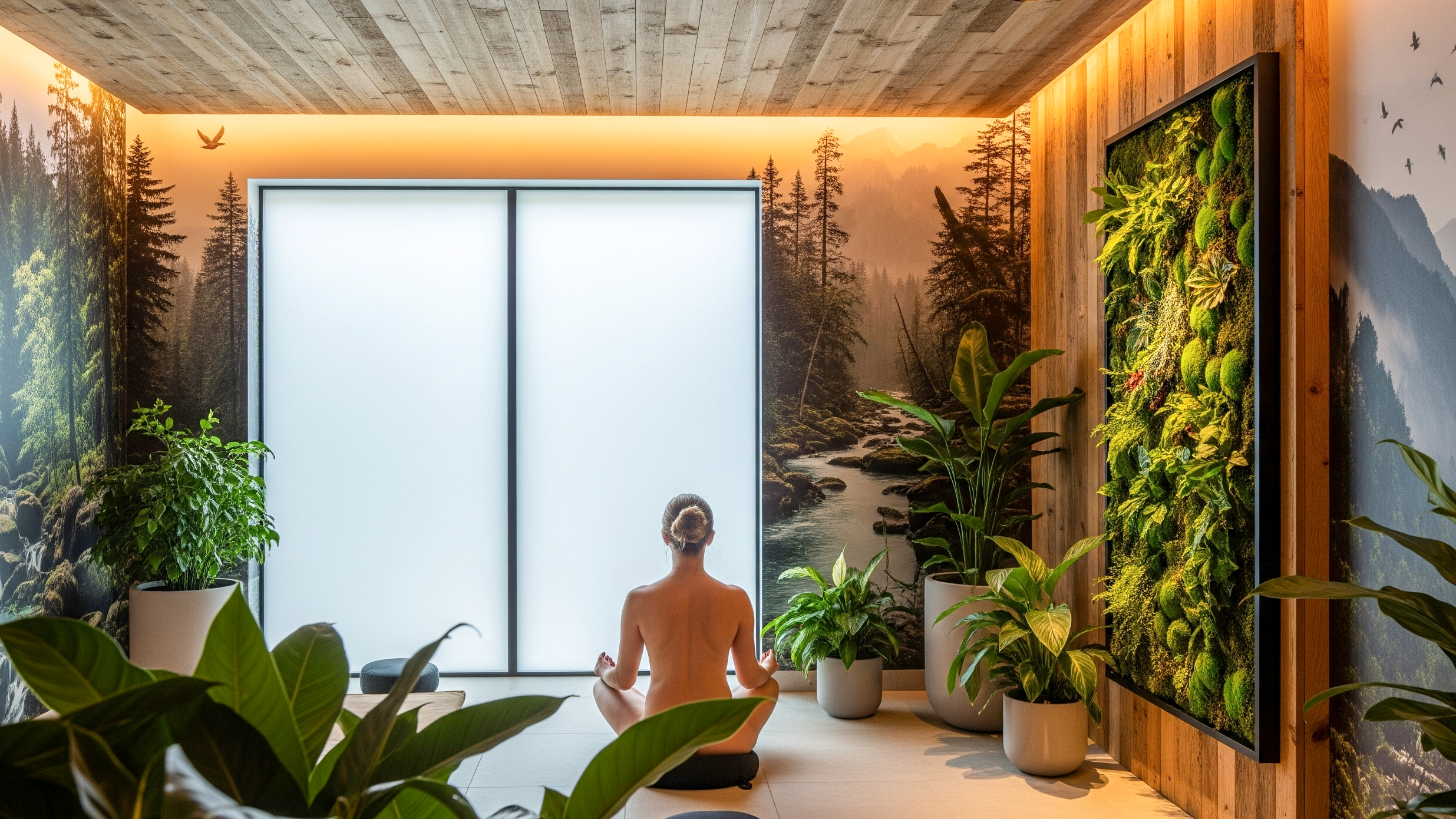
Meditation should be comfortable and sometimes that means having to avoid bad weather. This is where the principles of biophilic design can be used to create indoor spaces that evoke a sense of being in nature, even when actually being in nature is not practical.
This means using a combination of elements including using natural materials, plants, natural colour schemes and textures. The most important thing is to be free from distractions and to feel comfortable.
Meditation is all about noticing how you feel. When it works well, you get into a state of calm, relaxation and mental clarity. Having that interrupted by noise or sudden changes in light or temperature can spoil things.
In the home, a living room or bedroom can be ideal. So, how could you set about creating an aletheic space for meditation?
Here are some general principles.
Mindful decluttering
Regardless of the room’s primary function, the most crucial step is to keep the space free from unnecessary distractions and clutter, so if possible, keep non-essential items stored away and out of sight when not in use.
Natural materials and colours
A palette of subtle, natural colours like warm whites, greens and earthy tones can be relaxing. Use materials such as reclaimed wood for furniture, linen for soft furnishings, and wool or jute for rugs. This creates a calming, organic feel that connects you with nature.
Layered lighting
Instead of a single harsh overhead light, use multiple sources. Consider a floor lamp with a linen shade for soft, diffused light, and maybe a small, warm-toned lamp on a side table. This allows you to create a gentle ambiance for meditation that differs from the room’s everyday use.
A designated zone
Use a large rug to define the meditation zone. Use furniture, such a s a coffee table, which can be easily moved to the side when you want to meditate.
Plants
Incorporate a few large, statement houseplants in nice pots. Their large leaves will not only add a touch of nature but can also serve to create a sense of seclusion and privacy when you sit near them. Moss panels on the walls can also add some biophilic elements – they are tactile, green and also have good acoustic properties.
The bedroom as a meditative space
A bedroom is naturally a more private space, making it an intuitive choice for a meditation sanctuary. If floor space is limited, the bed itself can be used. the most important thing is to be able to focus on your feelings without distraction. Natural linen bedding in neutral colours would be ideal.
Adapting the Space for nude meditation
Your space should support your meditation practice without feeling forced or exposed, so try to position your meditation spot in a way that provides privacy. Remember, though, that the aletheic concept is also about uncovering something about your own nature in your environment. That slight sense of exposure or vulnerability can be quite revealing, so while protecting your own privacy, don’t lock yourself in.
The careful placement of plants can provide a sense of seclusion and privacy while allowing light to permeate the space through the foliage.
Using foliage near windows and light sources can also create wonderful shadows, which can be used to create areas of partial concealment and intimacy, allowing you to feel both exposed to the environment and protected within it.
Spas and wellness spaces
Many health clubs, spas and other wellness spaces provide space for meditation. These days, even some workplaces provide wellness rooms (although they are often not used as in some organizations, their use can be viewed as a sign of weakness, which many people do not want to risk).
I think that there is an opportunity for health spas, hotels and other wellness spaces – beyond existing naturist clubs – to offer space for nude meditation. Not everyone that would use such spaces would consider themselves naturists or be members of a naturist club or society, but may very well wish to take advantage of a space where they could disrobe and make a complete, unconcealed connection with nature.
This is also an opportunity for naturist venues to widen their offer and open some of their spaces up for focused activities such as solo nude mediation. This could make it easier for some people to consider aspects of naked wellness without having to jump into the full gamut of more traditional naturist activities.
Interested in an aletheic space for your home or naturist club?
Get in touch to book a consultation and let’s design a calming, authentic environment together.
Humans traditionally recognize five senses, but we actually possess many more. These senses work together to interpret the environment, essential for survival. Modern urban settings can overwhelm our senses, leading to stress. Biophilic design aims to restore sensory balance by incorporating nature, enhancing comfort and overall well-being, much like the harmony of an orchestra.
Introducing the sense orchestra
Consider vision. What do we actually sense with our eyes?
We use our eyes to see shapes, estimate distances, perceive colour, determine brightness, work out which way is up, detect movement, tell us about the direction we are facing, or moving towards, and estimate speed. Changes in brightness and daylength tell us about passing of time and the change of the seasons.
Our eyes are very much our primary sense, but what we see makes more sense if it is confirmed by what we hear, smell, touch and taste.
Our stereophonic hearing helps us to know where we are in relation to the source of the noise. Is it to our left or right, or even behind us? Is it moving towards us or away? And other tiny organs in our ears work in harmony with our eyes to tell us which way is up and how fast we are moving and turning.
Our eyes, nose and mouth working together are critical for telling us whether something is safe to eat, and our tongue is more than just a collection of taste buds – it is full of sensors that inform us about textures and temperatures.
We have sense organs inside our body. They tell us if we have indigestion or when we have an infection, or have sustained damage. Understanding and interpreting our internal senses is called interoception – a new word for me.
Our biggest sense organ is, of course, our skin. It tells us so much about our environment. We detect temperature, texture, hardness, malleability, size, shape and the quality of materials. The hairs on our skin can respond to changes in static electricity and there is no doubt that touch can generate the most intense pleasure.
Composing the piece
Human senses work together to help us to understand our environment, or rather the environment that we spent well over 90% of our existence (maybe as much 99% if you include our immediate hominid ancestors).
Our senses evolved to allow us to survive in a particular environment: open savannah. This environment is characterized by open vistas, undulating terrain, scattered and clustered vegetation and plenty of water. It was quite warm, although there were some seasonal variations. In our ancestral, natural environment, our senses told us about opportunities and threats. However, they need to work in harmony to give us the full picture.
The modern, urban environment is quite a long way from those open plains. Buildings mean that sounds echo around so the direction we hear from is not the same as where we see the source. We bombard some of our senses whilst simultaneously dull others. After all, we cover most of our largest sense organ, most of the time, and deprive ourselves of gaining vital information about our environment.
These confusing, discordant inputs cause stress. We have to make a lot of mental effort to understand what is going on.
Melody and harmony
The practice of biophilic design – bringing a sense of nature into our built environment – is a step towards correcting this sensory discord. It often focuses on the visual sense by incorporating natural views, plants, and natural light, and it is becoming increasingly commonplace in modern design.
However, an aletheic environment brings a new level of comfort and restoration by going even further. The idea is to provide complete, harmonious sensory stimulation that restores the connection our ancestors once had. While it may not be possible in every space (office naturism is probably a step too far for most), we can create restorative environments in our places of leisure and living that allow us to experience this deep reconnection.
The orchestral score
The metaphor with music is a good one. By thoughtfully designing spaces that appeal to all of our senses in an unfiltered way, we can go beyond simply adding plants. We can compose a full symphony, where every input works together to create an experience that is far more than the sum of its parts.
Forest bathing, or Shinrin-yoku, enhances well-being by immersing oneself in nature, reducing stress and anxiety while boosting mood and cognitive function. Usually practiced clothed, nudity may deepen the connection to nature. Ultimately, the goal is to connect with the natural world, promoting joy, peace, and personal renewal.
Note: This post explores the psychological and wellbeing benefits of naturism within natural and biophilic environments. It contains illustrations depicting nudity and the human form.
Forest bathing, or Shinrin-yoku, is a Japanese practice that involves immersing oneself in a forest environment, aiming to improve overall wellbeing. This therapeutic activity has gained significant traction worldwide, with scientific studies increasingly validating its numerous benefits.
While the concept of connecting with nature is universally appealing, there is a growing movement to carry out this activity naked as a way to amplify the restorative powers of forest bathing.
Restoration and relaxation
The allure of forest bathing lies in its ability to reduce stress and anxiety. Studies have shown that spending time in nature lowers cortisol levels, the hormone associated with stress. The forest environment, rich in phytoncides – volatile organic compounds emitted by trees – has been linked to boosting the immune system and improving mood. Recent research has also shown how trees radiate beneficial near infrared radiation as well.
Furthermore, the soft, earthy hues, the gentle rustling of leaves, and the melodious bird songs create a serene atmosphere that promotes relaxation and mental clarity.
Moreover, forest bathing has also been shown to enhance cognitive function. Research suggests that spending time in nature can improve attention, memory, and creativity. The absence of digital distractions and the opportunity to engage with the natural world offer a much-needed respite from the constant stimulation of modern life. Studies have also indicated that forest bathing can lower blood pressure, reduce the risk of heart disease, and improve sleep quality.
While these benefits are undeniable, there is also a compelling argument for incorporating naturism into the forest bathing experience.
Complete immersion
Nudity, often associated with vulnerability and authenticity, can deepen the connection with nature. By shedding societal constructs and physical barriers, individuals can fully immerse themselves in the forest environment, allowing their senses to be heightened. The absence of clothing can reveal a sense of freedom and liberation, promoting a deeper state of relaxation.
Furthermore, naturism facilitates a more intimate connection with one’s body. By accepting and embracing one’s physical form in a natural setting, individuals can develop a healthier body image and self-esteem. The experience of being naked in nature – the ultimate act of aletheia, or truth-revealing – allows the body’s true unity with the environment to be revealed, breaking down the artificial boundaries between humans and the environment.
The idea of nude forest bathing may be confronting for some. Cultural norms and personal comfort levels vary greatly, so the decision to embrace naturism is entirely personal. Forest bathing is certainly beneficial with clothing, but my personal experience suggests that it can be much better without. The core principle is to find a way to connect with nature in a way that promotes well-being.
It is wise to choose a secluded and private forest location and it might be a good idea to join an organized group if you are a novice or a bit nervous about the idea.
Forest bathing can be a powerful tool for enhancing physical and mental health. By immersing oneself, totally, in the natural world, individuals can experience a range of benefits, from stress reduction to improved cognitive function. The absence of clothing maximizes the absorption of beneficial far red and near-infrared wavelengths (radiated by trees and sunlight) across the body’s largest organ (the skin).
While clothing is not a barrier for enjoying the forest environment and the benefits of forest bathing, naturism offers a unique opportunity to deepen the connection with nature and oneself. Ultimately, the most important aspect is to find a way to connect with the natural world in a way that brings joy, peace, and renewal.
And for those who are open to exploring naturism, forest bathing could be the perfect gateway. Short, gradual exposure to nudity in nature, maybe in private, will help build comfort and confidence.
Disclaimer: This article is intended to provide information and does not constitute medical advice. It is essential to consult with a healthcare professional before making significant changes to your lifestyle or engaging in any new activities.
An aletheic environment is a space intentionally designed for unconcealment – stripping away the artificial to create an authentic, unfiltered connection between people and the natural world.
Aletheia is a Greek term for truth or unconcealedness. It is pronounced al-er-thee-ah
In philosophy, Aletheia is one of the primary Greek words for truth. However, its meaning is distinct from a simple fact or statement. It refers to a state of being revealed or unconcealed. Truth, in this sense, is not something you make or construct, but rather something that exists and is brought into the open or un-hidden.
An aletheic space is intentionally unconcealed, authentic, and revealing.
It is a place that strips away the artificial and the inessential to reveal a deeper truth – both about the natural world and about ourselves.
This could mean a space that is designed to help its users reconnect with their natural place in nature. It could also be a place for or being in, or taking part in activities, that can reveal more about our own nature.
Unfiltered connection
Aletheic spaces are where the barriers between the occupant and the natural environment are minimised or eliminated. They are spaces where all of our senses are stimulated to uncover the whole truth about where we are and what we are doing.
For an activity, it could simply be a natural environment where a true connection between the person and their surroundings can be unconcealed. It might be something as simple as taking exercise in nature rather than a gym, meditation in a garden or the practice of forest bathing.
For a building, this could involve incorporating elements of biophilic design. This is where a sense of nature is brought into the built environment by incorporating views of nature, plants and living walls that make the boundaries between inside and outside disappear, soundscapes and scents, or materials in their raw, honest form like exposed wood or stone.
Honesty in design
An aletheic space would be authentic. It would not rely on superficial decoration to appear natural, but would be created with materials that are true to their function and with a design that connects people with nature and and environment.
Most importantly, an aletheic space would be a place where the occupant themselves feels free to be “uncovered” and authentic. It would be a space with an atmosphere of safety, trust, and liberation. A space to become unconcealed and where one’s natural, naked, state is celebrated, allowing for the deepest possible connection to the environment. A space where you stop being an observer of nature and become a part of it.
FAQs
What is biophilia?
A good definition of biophilia is the innate need for humanity to connect with, and be a part of, nature. From an evolutionary point of view, the sense of ease and comfort we get when we are connected with nature can be explained by being in an environment where our senses tell us that we are safe.
What is biophilic design?
Biophilic design is a design principle that is inspired by nature and incorporates natural and naturalistic elements into buildings and the wider built environment with the intention of improving wellbeing. An easy-to-understand (and almost definitive)guide to the principles of biophilic design can be found here.
What is naturism?
Naturism is a way of life in harmony with nature characterised by the practice of communal nudity with the intention of encouraging self-respect, respect for others and for the environment. (INF-FNI definition).
What do you mean by ‘complete immersion in nature?’
Removing the barrier of clothing to our skin offers an unparalleled level of total sensory immersion. It intensifies the connections with nature and our environment. The feeling of air, sunlight, bare earth and the weather directly on the skin promotes a deeper sense of tranquility, mindful awareness, and interconnectedness. This enhances mental restoration beyond the baseline benefits of nature exposure alone.
What is the difference between a biophilic space and an aletheic environment?
Aletheic spaces are where the barriers between the occupant and the natural environment are minimised or eliminated. They are spaces where all of our senses are stimulated to uncover the whole truth about where we are and what we are doing. They can be natural, but where access to nature is limited, they can be designed.
When designed and part of the built environment, they are places for more than just for doing stuff in (or for getting a credit on a checklist), but are places where restoration, sensory coherence and mental clarity can be given every opportunity to occur. It would be a space with an atmosphere of safety, trust and liberation.
Most importantly, an aletheic space would be a place where the occupant themselves feels free to be uncovered and authentic.




Leave a Reply