The prolonged summer in Southern England has led to drought and parched landscapes. Observations of seasonal changes evoke memories of agricultural traditions and community rituals. As autumn approaches, opportunities for reflection arise amidst nature’s cycles, underscoring the importance of appreciating the passage of time and the changing seasons.
The end of a long, hot summer
Here, in Southern England, the summer has been long, hot and very dry. Apart from a thunderstorm in June and and a couple of light showers earlier this week (late August), there has been no rain for almost three months.
Five official heatwaves and more days over 35 Celsius than ever before has meant that the landscape is parched and many trees are already dropping their leaves. This is sometimes called a ‘false autumn’. England’s green and pleasant land is currently very brown.
Autumn is often viewed as the beginning of the end of the year – nature getting ready ready for winter. Migratory birds will start to (or already have) head South and squirrels will be caching their nuts. It is only a month until the equinox.
At some point, the warm weather will come to an end (although the long range weather forecast suggests periods of above average temperatures may return in September) and the rain will return.
Noticing the seasons
As a child, growing up in the 1970s in a village in the Lincolnshire fens, I was always very aware of the changes in the seasons – not just as the landscape went from black to green to gold and back again, but also because our village community, in common with thousands of others, maintained seasonal rituals that were rooted in farming practices, especially those in summer and autumn.
A field in the Lincolnshire fens. Image by Jay Hayward (Creative Commons Attribution Share Alike 2.0)
There was ploughing (with lapwings and gulls following the plough), and ploughing matches – yes, farmers competed (and still do) against each other to see who can plough the straightest furrow and they have special competition ploughs to do it.
The sugar beet harvest marked winter, with the rivers of mud on the roads and the stench of the local sugar factories (even from ten miles away, if the wind was blowing the wrong way, you could smell them).
Spring brought emerging crops and, a few miles to the East, the bulb fields and the annual Tulip festival in Spalding. At that time, coach tours from all over the country would visit the Lincolnshire bulb fields, which rivalled those in the Netherlands.
Midsummer was the time of village fetes, always held in a farm yard. Late summer brought the cereal harvest (followed, in those days, by stubble fires) and then, in the autumn came my favourite – the harvest festival.
Village church. Image by Richard Croft (Creative Commons Attribution Share Alike 2.0)
Even as someone who has never been remotely religious, there was always something special about seeing the mountains of fresh produce and specially-baked loaves (made to look like wheat sheaves) adorning the village church. Harvest festivals with their optimistic hymns and harvest suppers were a very obvious reminder that the food we ate came, almost miraculously, from the land around us, grown with real expertise.
I studied Agricultural Botany at university, and worked in agricultural research for several years – that certainly kept me in touch with natural cycles. Then, I changed track and entered the world of workplace design and interior landscaping. After a quarter of a century embedded in offices, the seasons were almost obliterated from day-to-day thought (apart from the odd day of snow disruption).
In fact, as an interior landscaper, putting plants into buildings makes one acutely aware that the insides of buildings don’t have seasons – it is the lack of seasonal variation that determines the types of plants that can thrive indoors – those that are adapted to near constant light and heat.
The pulse of nature is not only noticeable from the countryside. In the UK, we are very lucky that our urban areas are generally well provided with public parks and gardens, and these provide very necessary spaces for people to gain the benefits of fresh air and sunshine, as well as to appreciate nature. Indeed, many of our parks are richer in wildlife than the countryside.
The forced pauses in our routines give us time to reflect and gather our thoughts. Noticing the changes in seasons – the result of the inevitable progress of the Earth orbiting around the sun as it has done for over four billion years – has provided me with a very necessary reconnection with nature and the passage of time.
Autumn is a period of new beginnings
September sees the start of the academic year and children will be back at school after a long summer break. Students may be starting a new phase in their life as they begin their studies at university, and new graduates and school leavers may be looking for their first jobs and their passage into adulthood.
Farmers will be sowing seeds for next year’s harvest and wine makers (of which there are many in this part of the country) will begin to harvest their grapes. Retailers will be getting ready for the Christmas shopping season too.
Grapes ripening on a vine in the author’s garden
Moving indoors
It is also the time to start thinking more about our indoor environments and how to create spaces and opportunities for peace and contemplation.
It’s not yet time to light the fires and bring out the blankets, but the opportunities for getting the full benefits of nature outdoors – especially the sensory inputs facilitated by a full immersion in nature – may diminish.
As I get older, I reflect on the fact that I may have fewer than a hundred seasons left. Taking the time – and making the effort – to appreciate the fascinating ways in which nature changes (and how my body experiences it over time) becomes more precious.
I’m lucky in that I have the time (I don’t work as much as I used to) and the space to explore nature as much as I want. I intend to make the most of that good fortune.
In this post, I reflect on learning how photographs of my body – often nude and in natural settings – can help me to appreciate my body, capturing its changes over time. This process promotes self-compassion and acceptance, shifting focus from societal aesthetic standards to self-witnessing. Although not a complete solution for body image issues, it can serve as a valuable tool for personal appreciation.
Note: This post explores the psychological and wellbeing benefits of naturism within biophilic environments. It contains illustrations depicting nudity and the human form.
A few months ago, I wrote this post about learning to respect and appreciate our bodies as they are and what they are capable of as we journey through life. By seeing our bodies as a record of our lives rather than worry about aesthetics and idealised beauty standards, we can manage some self compassion and self acceptance.
I’ve been thinking about that more recently as I have been adding posts to this site and trying to find ways of illustrating those articles.
From mirror to lens
This has led me to taking photographs of myself, often nude and in nature. I’m not a great photographer and only use the camera on my phone, but I have been teaching myself about composition and have been trying to get better at it. I don’t use models and I’m trying not use ai-generated imagery unless I can’t create the illustrations I want without it.
This has led to a growing collection of images over the last year. They have shown fluctuations in weight, changes in the way I hold my posture (partly as a result of some pain and joint problems) and even changes in the way my skin and hair look.
Some of this is seasonal (this summer has led to quite a tan), some of it might be diet related (I’m trying to eat healthier) and some is just simply due to ageing.
It is fascinating, though, to notice the changes. They form a record that can be referred to rather than relying on a memory from looking in mirrors. It really does help me to recognise the truth that my body changes.
Self witness
In the previous post on this subject, I said that goal is to shift from the cultural habit of self-surveillance (judging the body against an ideal) to self-witnessing (accepting the body as an honest expression of life).
I still I catch myself out when I see myself in a mirror and I think to myself “that’s not a good look”. This still triggers an emotional response that makes me value myself differently. But I am now, often, a lot less susceptible to self doubt and diminished self esteem.
Looking at the pictures that I’ve taken is a very useful form of self witness. A mirror provides an instant reflection that triggers an instant response. Photographs are different – they are a moment caught in time that are looked at later, reviewed, examined, thought about.
Taking lots of naked selfies is not a panacea to overcoming poor body image, but it might be a useful tool. I find it helpful, but it might not work for everyone, especially if there is a risk of reinforcing more entrenched body image difficulties.
The body as a component of its environment
I have learned to appreciate my body more, and some of the pictures I take in nature really do show that the human body – no matter how ‘imperfect’ – is as much a part of the rich tapestry of nature as the trees and wildlife.
Naturists often think of themselves about being a part of nature, not just being in (or even observing) nature. I agree.
The process of taking those pictures has also been a learning experience. The physical process of stepping into nature, setting the camera, and standing exposed to wind, light and air is itself a sensory aletheic act. Finding just the right location to capture the mood whilst avoiding unwanted elements requires some thought. Then finding somewhere to place the phone, set the timer and then position myself to make sure that I’m properly framed needs to be considered.
Thinking more about it, the act of photography acts as an unmasking tool and it is a literal unconcealment. It is a way of stripping away both physical clothing and mental filters and projections to see what is actually there.
In this post, I reflect on my frequent visits to nearby woodlands, particularly from spring to summer. I have made the effort to intentionally noticethe way the woodland changes with the seasons, as well as how I experience it. The unseasonal heatwave intensifies the sensory experience of the forest. The practice of forest bathing enhances my appreciation of nature, highlighting humanity’s connection to the environment.
Note: This post explores the psychological and wellbeing benefits of nudity and naturism within natural environments. It contains illustrations depicting nudity and the human form.
There are some nice woodlands close to where I live. I visit them several times a week – especially in the spring and summer – for walks and to engage in forest bathing. I have been to this patch of woodland several times since the middle of April this year and have made the effort to notice the transition from spring to summer.
There was a profusion of bluebells on the woodland floor in the spring…
… then the gradual growth of foliage in the shrub layer followed by the development of a dense canopy in early summer.
Over the last two or three weeks, the sounds of birdsong have been more intense and noticeable. Rabbits and squirrels are more common, molehills are appearing and woodland species of butterflies are making an appearance. Yesterday, I saw a woodpecker.
I noticed some other things too.
At the time of writing (24 June, 2026), here in Southern England, we are experiencing an unseasonal heatwave with record-breaking temperatures being predicted. In the early hours of yesterday morning, there were intense thunderstorms and heavy downpours. The woodland floor was damp and the air was still and humid.
The first thing I noticed was the smell. They were so much more intense than normal. Sweet floral notes and earthy, mossy, fungal vegetal odours combined in ways that were surprising.
The way my skin felt was very different. The warm, still, humid air felt as if it was enveloping me. Just about every one of my senses was awakened and seemed more sensitive.
The contrast between yesterday and three days before was remarkable.
That contrast in experience may be because I have been making an effort to notice my environment more – something that is an essential component of the practice of forest bathing. It is almost certainly amplified by being able to experience a totally immersive sensory experience by being naked. I am sure that the changes in the way the air felt wouldn’t have been as obvious were my skin to be covered.
Aletheia is all about experiencing the truth of the environment and our unconcealed place in it. This purposeful noticing of the environment, rather than the passive acceptance of our place in it really makes a difference to my appreciation of nature, our vulnerability in its majesty, but also the way that nature changes over time.
I am not a religious person, and I have written before about my humanist outlook. However, immersion in natural places explains why so many religions are rooted in respect and worship of nature – human survival is deeply entwined with the survival of our natural environment.
This post discusses the psychological benefits of naturism in biophilic garden environments, highlighting the importance of year-round usability. It emphasises using structural planting and shelter to combat wind and enhance comfort in cooler months. Aletheic gardens promote genuine sensory connections between the body and nature, inviting more immersive outdoor experiences.
Note: This post explores the psychological and wellbeing benefits of naturism within biophilic environments. It contains illustrations depicting nudity and the human form.
Making it usable across more of the year
The single most common limitation of the private garden as an aletheic space is not being overlooked, or lack of planting, or poor design – it is the assumption that it is only usable in warm weather. Where I live, in Southern England, this effectively restricts use of the garden to three or four months of the year in many people’s minds, and to perhaps five or six in practice. The remaining half of the year, the space lies largely unused. It is observed from inside, but rarely inhabited.
This is a significant missed opportunity. As I explored in the spring post earlier this year, cold air on bare skin is not simply an obstacle to outdoor experience – it is itself a rich form of sensory experience that warmer conditions cannot replicate. The physiological contrast between cold outdoor air and warm interior space can be genuinely restorative.
Thermal and airflow variability – subtle, natural shifts in temperature and air movement – can be useful elements of biophilic design, precisely because our nervous systems respond to these shifts with increased alertness and a heightened sense of presence.
Cold is not the enemy, but a cold wind might be
The practical challenge is not to make the garden warm – that is largely impossible and probably undesirable – but to make it sheltered, usable, and inviting across a wider range of conditions than a fully exposed space allows.
Wind is the primary enemy of year-round garden use, and it is more easy to dal with than temperature. A south-facing garden space that is well-sheltered from the prevailing south-westerly wind will feel dramatically warmer and more comfortable than an identical space that is exposed to it.
Structural planting on the windward side – dense, layered, and tall enough to deflect and diffuse, rather than simply block the wind – is more effective than a solid fence or wall, which can create turbulence on the leeward side rather than calm.
Evergreen species, such as yew, holly, several conifers, and even plants like hardy Cordylines or Phormiums can perform well as windbreak planting in Southern England, combining density with year-round foliage. Bamboo can be useful too, as long as you can tame it and avoid invasive varieties.
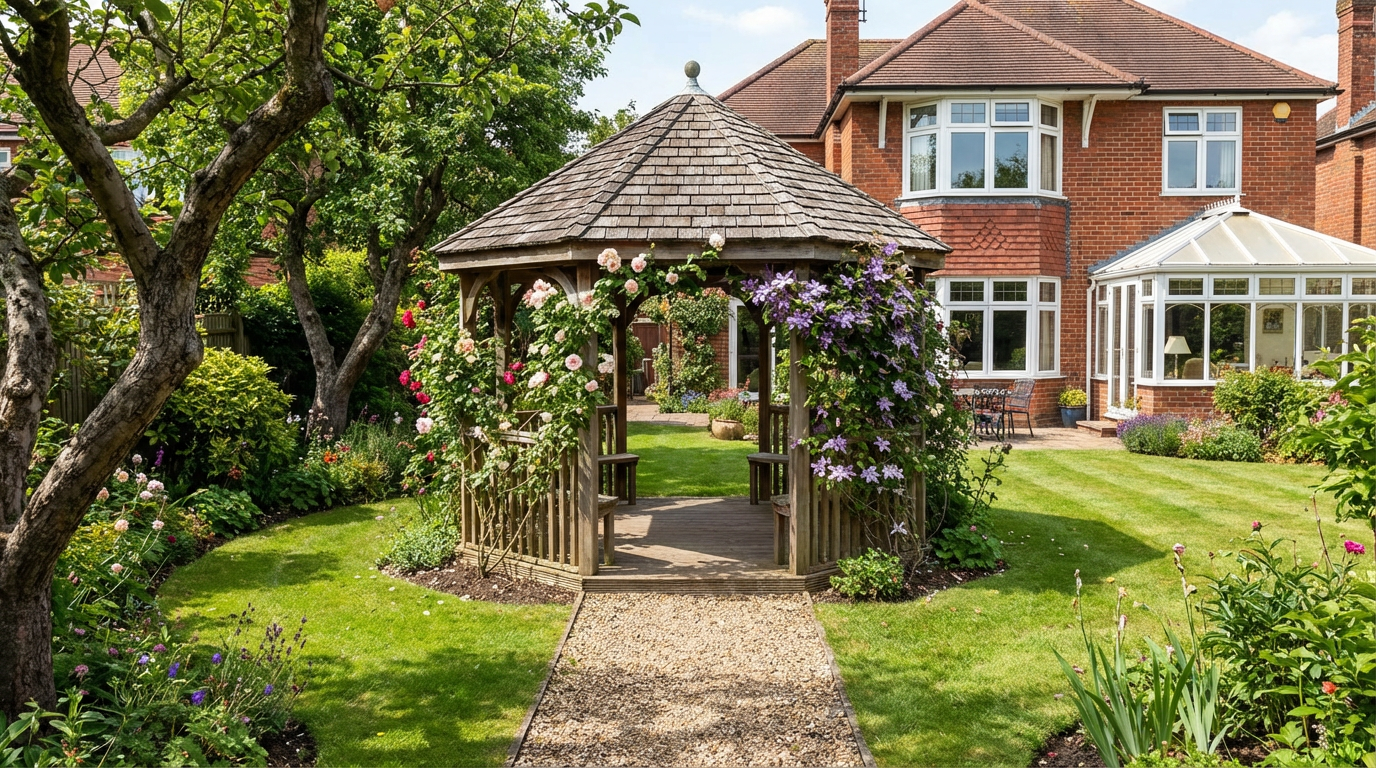
A wooden gazebo adorned with climbing flowers serves as a peaceful retreat in this beautifully landscaped garden.
Overhead shelter is the other key intervention. A well-designed pergola or canopy structure over the primary seating or standing area of the garden transforms the usability of the space in rain and in cold – not by excluding the weather, but by providing the psychological and physical security of a roof without the enclosure of four walls. Under a gazebo, you are still in the garden, still exposed to air movement and ambient sound and the smell of rain on soil. You are simply not getting as wet, and the difference in how long you are prepared to remain outside is considerable.
Thermal mass – the ability of a material to absorb heat during the day and release it slowly through the evening – is worth considering in surface and wall choices. A south-facing stone or brick wall absorbs substantial heat on a clear day and radiates it back through the late afternoon and evening, creating a microclimate that can be several degrees warmer than the open garden. Seating areas positioned close to such walls, or surfaces of stone or dark-coloured porcelain that warm quickly in winter sun, extend the comfortable use of the garden significantly into the shoulder seasons.
We can also learn something from the Scandinavian approach to outdoor living. There are many accounts about how northern Europeans maintain engagement with outdoor space during the winter through a combination of shelter design, appropriate clothing, and cultural expectation – a willingness to be outside in conditions that would keep most British people indoors.
A garden that has been genuinely designed for year-round use invites a different relationship with outdoor time than one that has not. Shelter, thermal comfort, and all-season planting that offers interest in February as well as July all contribute to adding to the usability of the space.
Small gardens, big potential
Before addressing maintenance, it is worth pausing on something that might have made parts of this post feel aspirational rather than practical. References to tree canopies, gazebos, windbreak planting, and transitional spaces can suggest a scale of garden that many don’t have – I don’t (but would like to). The reality is that the majority of domestic gardens are small – often quite small – and the aletheic principles discussed here need to work within that constraint if they are to be useful at all. They need to work in courtyard gardens and even balconies as well.
The good news is that they do, and in some respects a small garden is better suited to aletheic design than a large one.
Enclosure and privacy – the foundational requirement – is considerably easier to achieve in a small space. A garden of thirty or forty square metres can be effectively screened with a modest investment in climbing plants on existing boundaries, a couple of well-chosen structural shrubs, and perhaps a simple trellis extension to an existing fence. The same result in a large garden might require years of planting establishment, significant structural work – and a lot of expenditure.
Intimacy, which is central to the aletheic experience, is a natural property of small spaces rather than something that needs to be designed in. A small, well-planted garden can feel genuinely enveloping – a quality that larger gardens often struggle to achieve and that landscape designers frequently spend considerable effort trying to create through division and enclosure. The Japanese tsubo-niwa tradition, in which tiny courtyard gardens of just a few square metres are designed as complete, immersive sensory environments, demonstrates that scale is no barrier to depth of experience.
Scent, in particular, works powerfully in small spaces. The concentration of fragrance in an enclosed area of modest dimensions can be extraordinary – a single well-placed Trachelospermum jasminoides (star jasmine) on a warm wall, or a pot of Nicotiana near a seating area, can fill a small garden with scent on a still evening in a way that would be lost in a larger, more open space.
Nicotiana flowers. Photo by Leon Huang on Pexels.com
Water features scale down well too. A small millstone or bowl fountain requires very little floor space, uses minimal water, and produces the non-rhythmic sound that is one of the most reliably restorative elements of any outdoor space. In a small garden, the sound of moving water is audible from every corner – an advantage that diminishes as the space grows.
The main challenge in a small garden is not aletheic at all – it is practical. Space on the ground is limited, and every design decision has an opportunity cost. A seating area takes space that might otherwise be planted. A water feature takes space that might be used for movement or exercise. These are genuine trade-offs, and they require honest prioritisation. The starting question should be: what do I most want to do in this space, and what does it need to feel like in order for that to be possible? The answers to those two questions will resolve most of the subsequent decisions.
A small garden that is well-enclosed, thoughtfully planted for scent and texture, acoustically considered, and oriented to make the most of available light is not a compromise version of an aletheic garden. It is simply an aletheic garden at a scale that most of us actually live with.
A note on maintenance and honesty
There is a tension at the heart of garden design that is worth naming directly, because it has a bearing on the aletheic ambition.
A garden that is constantly managed – clipped, staked, deadheaded, and presented in a state of controlled perfection – is not, in the deepest sense, an honest garden. It is an attempt at taming nature rather than nature itself. This is not to say that maintenance is wrong, or that a well-kept garden cannot be beautiful and restorative, or that it cannot make use of non-native species. It clearly can. But there is a difference between a garden that is cared for and one that is curated to the point of artificiality, and that difference has aletheic implications.
Aletheia is, at its core, about the removal of concealment – about allowing oneself and our environment to be seen as they actually are, rather than as we might prefer them to appear.
A garden designed on aletheic principles might, ideally, reflect the same honesty.
This means choosing plants that are genuinely suited to the conditions rather than ones that require constant intervention to survive. It means allowing some degree of natural process – self-seeding, seasonal dieback, the occasional plant that does something unexpected – rather than maintaining absolute control over every element.
It means designing for low maintenance – not as a compromise but as a philosophical position. A garden that largely looks after itself is one that is being honest about what plants actually do when left to their own devices.
Naturalistic planting design, as developed and popularised by designers such as Piet Oudolf and Nigel Dunnett, aligns well with this principle. The emphasis on plant communities rather than individual specimens, on seasonal change rather than year-round perfection, and on the structural beauty of seedheads and winter stems rather than the removal of anything that is not in flower, produces gardens that are both lower in maintenance and more honest in their relationship to natural process. They also, incidentally, tend to be significantly better for biodiversity – which is its own form of aletheic truth about the garden’s place in a wider ecology.
This does not mean a garden that is neglected or chaotic. It means one in which the level of intervention is tuned to what is necessary rather than what convention or social expectation demands.
A lawn that is allowed to grow a little longer, a border edge that is not clipped to a perfect line, a climbing rose that is allowed to sprawl a little beyond its allotted space are not failures of maintenance. They are an honest reflection of what a living garden really is.
Gardening naked
An aletheic garden is one that you can experience naked as part of a process of truth seeking and revelation about yourself and your place in the environment.
It is also a place where you can interact much more intensely with garden by gardening naked.
This post coincides with World Naked Gardening Day in the Northern hemisphere. In 2026, this is the 2nd of May.
Since 2005,the first Saturday in May has been designated World Naked Gardening Day – an event that began as a gentle, good-humoured invitation to do something ordinary in an unconventional way, and which has grown into a genuinely international occasion with participants in dozens of countries. In the Southern Hemisphere, it is often celebrated on the last Saturday of October.
The premise is straightforward: go into your garden, take off your clothes, and do some gardening.
The tone has always been inclusive, body-positive, and deliberately undramatic about the whole thing.
It is not a protest, not a political statement, and emphatically not an excuse for exhibitionism. It is, at its core, an invitation to notice what happens when you remove the layer of clothing that separates you from the environment you are working in.
Which is, when you think about it, a rather aletheic proposition.
Gardening is already one of the more physically engaged relationships most people have with the natural world. It involves kneeling on soil, handling living plants, feeling the difference between dry and damp earth, being rained on, getting cold, getting warm, and generally being present in an environment that responds to what you do in it. It is one of the few activities in modern life that is genuinely multisensory in a natural rather than a designed way.
Research by the University of Bristol and University College London, published in the journal Neuroscience, identified that contact with soil bacteria – specifically Mycobacterium vaccae – stimulates serotonin production, which may partly explain the well-documented mood benefits of gardening. You don’t need to be a soil scientist to recognise the effect. Most gardeners know instinctively that getting their hands dirty makes them feel better.
Removing clothing for this activity does not change what gardening is, but it changes the quality of experience considerably. The sun on your back while weeding. The feeling of warm soil between your fingers without the barrier of gloves. The sensation of a light breeze across your shoulders when you straighten up. Grass under bare feet rather than through the soles of boots. These are not trivial additions to the experience — they are the difference between observing the garden and being genuinely immersed in it.
From an aletheic perspective, nude gardening is simply gardening with the volume turned up: the same activity, the same space, the same plants, but with the sensory filters removed.
There is also something worth saying about the practical reality of nude gardening that tends to get lost in the more philosophical treatment of naturism. It is, frankly, rather enjoyable. There is a lightness to working outside without clothing on a warm morning that is difficult to describe to someone who hasn’t tried it. There is a feeling of freedom and ease that has nothing to do with ideology and everything to do with the simple pleasure of being comfortable in your own skin, in your own space and doing something you enjoy.
The fact that it also happens to engage your largest sense organ more fully, support a genuine connection with the natural environment, and align with a coherent philosophical framework about truth and unconcealment is almost incidental. Sometimes things are good because they feel good, and the evidence is almost irrelevant.
World Naked Gardening Day is a useful occasion precisely because it offers a low-stakes, socially sanctioned moment to try something that many people are curious about but would not otherwise initiate. The knowledge that thousands of other people are doing the same thing on the same day – in their own private gardens, on their own terms, without any requirement to be seen or to perform – removes some of the psychological friction that might otherwise make the idea feel daunting. It is, in this sense, a small collective aletheic experience. It is a day when a lot of people quietly decide to be a little more honest about their relationship with their bodies and their gardens.
If you have a garden that offers reasonable privacy, a warm enough morning, and a willingness to try something slightly outside your usual routine, the first Saturday in May is as good a reason as any to give it a go.
The worst that is likely to happen is that you get a little cold and retreat inside for a cup of tea. The best is that you discover a quality of connection with your garden – and with yourself in it – that you hadn’t previously found available to you.
Finally, if you don’t have access to an outdoor space, there’s nothing wrong with some naked indoor gardening as well.
How I can help
Creating an aletheic garden – one that is genuinely private, sensory rich, usable across the year, and honest in its relationship to the natural world – requires a different set of questions from those that most garden design begins with. It starts not with what the garden should look like, but with what it should feel like, and what it should make possible.
My background in horticulture and plant science, combined with my work in biophilic design and interior landscaping, means I can help at whatever level is most useful – whether that is advice on structural planting for privacy and enclosure, a planting specification designed for sensory richness across the seasons, or a broader conversation about how the principles explored in this post might apply to a specific space.
If you are thinking about your garden differently after reading this, I would be glad to hear from you.
This article further explores the concepts of risk, peril, and awe within biophilic design, highlighting their psychological significance. I argue that these feelings reveal truths about our existence and relationship to nature, encouraging humility and recognition of our transience as humans. Ultimately, it suggests that experiencing awe fosters a deeper connection with the environment.
Note: This post explores the psychological and wellbeing benefits of naturism within biophilic environments. It contains illustrations depicting nudity and the human form.
Experience awe for a deeper connection to nature
I have previously written about risk, peril and awe. These are regarded as patterns of biophilia that are only just being developed as elements of biophilic design.
Risk / peril is thought of as a feeling of an unidentifiable threat. The biophilic solution leads to the knowledge that a reliable safeguard exists.
Awe relates to the stimuli that defy an existing frame of reference and which leads to a change in perception.
These two patterns can be the ones that can be most revealing of themselves and of ourselves. This is the bridge between biophilia and aletheia.
The patterns of risk / peril and awe are deeply rooted in our innate psychological and biological responses.
Aletheia is all about revealing the truth about oneself and the environments we use, so when a space where truth and unconcealedness are central, the experience becomes about confronting reality directly and authentically – and almost reverentially.
Awe and reverence
I am not remotely religious or spiritual. I am a humanist and am content in my belief that we have only one life. I try to make sense of the world through logic, reason, and evidence, and always seek to treat those around me with warmth, understanding, and respect. I don’t believe that there was a divine creator – I think we are the products of nature, evolution and happenstance.
That doesn’t mean that I don’t look on the world without a sense of awe. I do. I also respect and even revere nature and I am sympathetic to the concept of Gaia as expounded by James Lovelock – not as a superorganism, but as a metaphor for a self-regulating system of living and non-living processes.
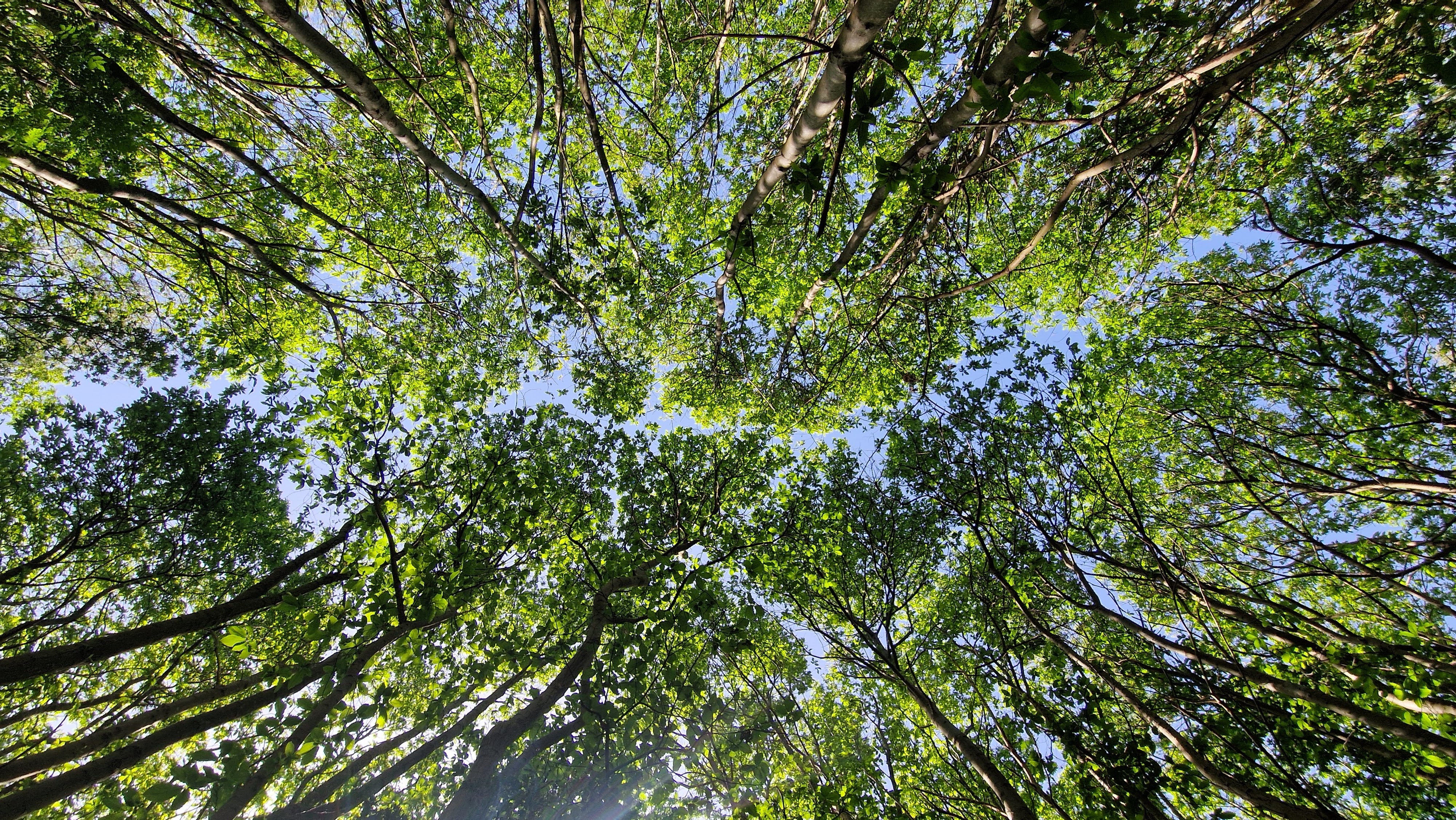
A forest canopy in Southern England. Image by the author
Nature is full of places that are jaw-droppingly astonishing and awesome in the true sense of the word. Humanity has created spaces with the specific aim of eliciting an emotional response – often religious (or at least worshipful), all the way back to the stone age.
Humanity has also created great art and music that inspires awe and reverence that can trigger profound emotional responses.
Awe is an emotion that can make one recognise vulnerability and help reveal the truth of our place in the grandness of nature and the vastness of time and space.
This is a healthy reaction. It helps us to recognise our personal vulnerability and also our need to be connected to the environment for our individual and collective survival.
As Carl Sagan reminds us, the Pale Blue Dot in space that is Earth is all that we have.
We are transient
If we are lucky, we will spend 80-odd years alive – about 0.03% of the amount of time modern humans have existed. That is not even a flicker in the 4.5 billion years that the Earth has been around.
It probably does us some good to experience awe as well as the feeling of humbleness as we reflect on our transience and in our position as just one of over eight billion humans alive today, and the countless billions who will ever have lived.
Strip away the artificial social armour of clothing and stand naked, alone in nature to get a real sense of the truth of our place in the universe.
Unhidden, unconcealed, unprotected. This is the reality of our existence – even for those of us fortunate to live comfortably.
In this post, I discus the complexities of body image and self-acceptance, highlighting the importance of appreciating one’s body for its functionality rather than aesthetics. The article emphasizes practicing self-compassion and creating mindful spaces to foster self-acceptance. Communal naturism is presented as a means to enhance body appreciation and reduce societal judgment, promoting overall well-being.
Note: This post explores the psychological and wellbeing benefits of naturism within biophilic environments. It contains illustrations depicting nudity and the human form.
“That’s not a good look”
I’m a generally happy, optimistic person. I have been very lucky in my life with a reasonably successful career, few health issues (so far), a happy family life and I am relatively financially secure. Objectively, I have little to worry about. And, most of the time, I muddle along happily in my little bubble of privilege.
Sometimes, though, I catch myself out. I see myself in a mirror and I think to myself “that’s not a good look”. This triggers an emotional response that makes me value myself differently – and not positively.
This is especially the case when I see myself naked.
Those accidental views in the mirror can nibble at my self esteem, and then I start doubting myself.
I won’t detail my self-perceived flaws beyond saying that I am a man in late middle age carrying several more kilogrammes than is probably good for me. My body is far from the idealised physique illustrated in the media.
Body acceptance is a tricky subject to address. Many people have hang ups about their appearance and there are no easy solutions. Even with the reassurance of loved ones and intimate partners, poor body self image can chip away at your confidence.
An aletheic perspective
The truth is that bodies age, change shape, and possess infinite variation. A true, honest look means accepting the body as it is in this moment, not as it once was, or as society dictates it should be. This view frames the body’s worth as intrinsic, derived from its capacity for experience and function, rather than an arbitrary aesthetic standard.
Aletheia (the Greek word for “unconcealment” or “truth”) establishes a philosophical foundation that moves beyond simple emotional positivity and toward a deeper, humanist appreciation of the body’s reality. The goal is to shift from the cultural habit of self-surveillance (judging the body against an ideal) to self-witnessing (accepting the body as an honest expression of life).
Shifting perspective
The human body is an incredibly sophisticated tool that allows one to experience the world and engage in your passions. For me, that includes gardening, walking in the countryside, cooking and enjoying food and wine (which may explain some of the parts of my body I’m least happy about). My body gives me the ability to enjoy my hobbies and pursue my professional interests and earn a living.
Practice functional appreciation: focus on the body’s abilities, not its aesthetics
When I look in the mirror, I now try to acknowledge the parts I find disappointing. I then immediately pivot to appreciating what my body does for me. I recognise the strength in my legs, the dexterity in my hands for work and hobbies and the ability of my digestive system to enjoy a good meal.
Instead of thinking “I see a pot belly”, I should try to acknowledge that “my core is the structure that allows me to spend hours walking in countryside or working in the garden, planting and weeding”. My body has carried me through six decades of life and work and should continue to do so.
This isn’t actually as easy as it looks when written down, but it is worth having a go.
Incorporate self-compassion
This is the opposite of self-criticism. It involves treating yourself with the kindness you would offer a good friend.
Have a mindful moment. The next time you feel that negative judgment looking in the mirror, pause and place a hand on the area you are criticising.
Acknowledge the feeling. Say to yourself that “this is a moment of discomfort. I am unhappy with how I look right now.”
Then offer kindness, as you would to a friend. Ask yourself “what do I need right now?” It is not usually more criticism, but acceptance. You might say “this is just one part of a whole, valuable human being. It is fine to look this way.”
Age acceptance: acknowledge the body as a living, ageing system
As we age, our bodies change. Try to view wrinkles, scars, and changes in size not as decay, but as growth rings or a patina of weathering patterns. A proof of your endurance and a historical record. Your body, from the day you were born to now, is a living document of experience.
Body part neutrality: unconcealment and treating all body parts equally
When you look at an area you dislike, name it neutrally, like describing a stone or a tree in a landscape. For instance, you see a finger, a knee, your feet or your belly. The parts are simply facts of the form, not a hierarchy of worth.
Mirrors redefined: use a mirror as a tool for truth, not judgment
The idea is to look for details, not defects – a slight turn of the muscle, the unique pattern of hair, the way the skin folds – and describe them factually, without assigning value.
How to create a biophilic, aletheic, mindfulness space
The aim is to create a space that embodies the unconcealed truth of the space to encourage greater self-acceptance.
The materials and environment should emphasize that the body is part of the environment, not a detached observer of it. There is beauty in its truth and functionality.
Biophilic design is all about creating physical and psychological comfort through the feeling of being connected to nature and the natural environment and for gaining the benefits of a coherent, harmonious space.
Key biophilic elements
Materials of truth
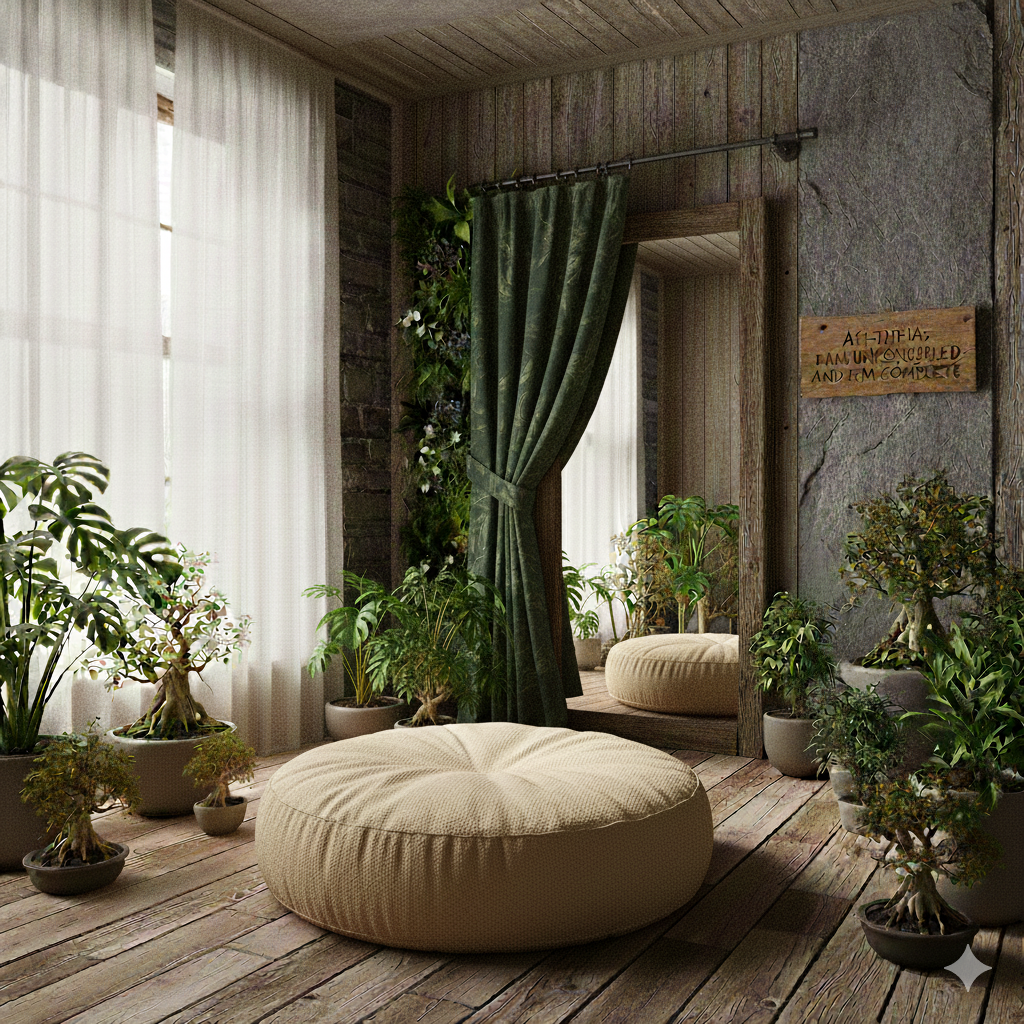
Use raw, minimally processed, or imperfect materials, such as exposed grain wood, unpolished stone, and materials that show their age (patina) as non-judgmental observers. They are imperfect, honest, and enduring, and they reflect those same qualities back onto the self, which reflect the body’s own truth.
Living greenery
Include numerous, vibrant living plants or features such as moss panels. Their natural cycle of growth, imperfection, and decay serves as a constant, non-judgmental metaphor for your own physical state.
Light and shadow
Employ diffused, natural lighting rather than harsh, direct light that emphasizes flaws. Diffused, natural light is ideal because it reduces visual surveillance, preventing the eye from fixing on harsh details and instead encouraging the holistic perception of the body as a natural, three-dimensional form. Soft shadows give depth and truth to the body’s shape. To avoid the flat, unforgiving quality of overhead indoor lighting, think about window light (perhaps with a voile curtain to soften and diffuse the light – and to provide some privacy) or lower level lamps on tables or shelves.
The mirror question: strategic inclusion
My negative reaction to a mirror might have led to its removal – that might have been an obvious reaction. However, mirrors are useful. So, when creating an aletheic space, the mirror can be included and used to re-train the mind.
Use a Covered Mirror
The mirror could be covered with an attractive fabric or a sliding panel, only to be unveiled as part of an intentional aletheic practice. This removes the risk of accidental, subconscious self-surveillance and forces a purposeful view of the whole body.
Non-Critical Viewing
When you unveil it, commit to a non-evaluative gaze for a set time (e.g., 60 seconds). Do not let your mind use judgemental words such as “good,” “bad,” “better,” or “disappointing.” Just observe shape, colour, texture, and light, as if viewing a sculpture or an unfamiliar landscape.
Indoors or outdoors?
This depends on your own circumstances and also the weather. If you have a secluded outdoor space, such as a balcony or terrace that you can adapt, then this sort of self reflection can be amplified. The exposure to the sky, fresh air and dappled sunlight diffused through foliage and the use of outdoor mirrors are effective. Such a space helps to make you feel part of the environment and your senses are brought to life.
From private critique to communal acceptance
I have written before about my being a naturist. This often means going to places where I am naked amongst a group of other naked people, whether at a club or on a naturist beach.
These are places where the whole body is on show – with all of its flaws and features that you find yourself doubting when in private.
The anonymity of a crowd
You are visible to many other people, most of whom you probably don’t know. However, those places are always free of judgement, and they are places where – despite being completely exposed – you can be completely anonymous. When everyone is naked, your own appearance no-longer seems to matter. For me, my anxieties about my body seem to vanish.
I’m not about to suggest that everyone with any sort of anxiety about their bodily self image should immediately head towards their nearest naturist beach – that could provoke all sorts of fears that might be too challenging as a first step. However, it is an option to consider, and there is peer reviewed research that supports its benefits.
Research in this area, largely led by UK-based psychologist Dr Keon West and his colleagues at Goldsmiths, University of London. The research strongly supports the claims that communal naturism has significant positive effects on body image and psychological wellbeing.
Communal naturism: a way to appreciation
The majority of empirical research focuses on the practice of communal nudity (social naturism) and consistently finds it leads to substantial psychological benefits.
Key Findings and Mechanisms:
Increased body appreciation. Studies consistently show that participants who engage in naturist activities report a more positive body image and greater body appreciation than non-participants, and this effect is often immediate and significant following an event.
Reduced Social Physique Anxiety (SPA). This is identified as the key psychological mechanism for the improvement. SPA is the anxiety resulting from the prospect or presence of the interpersonal evaluation of one’s physique. Being nude in a non-sexual, safe social setting normalizes the non-idealised human body, which reduces the fear of judgment (Social Physique Anxiety). This reduction, in turn, allows for greater self-acceptance. In essence, by seeing a diversity of natural, non-media-idealised bodies, the individual’s mind has less basis to fear their own body being judged.
Boosted self-esteem and life satisfaction. Increased participation in naturist activities is a significant predictor of greater life satisfaction, with this relationship being mediated by improvements in body image and higher self-esteem.
But what about solo naturism?
While the benefits of communal nudity are well-established, the research specifically on the effect of solo nudity at home, or self-image when alone is less abundant. Most of the available research focuses on activities done in the company of others. The practice of solo aletheic nudity (non-judgmental viewing of the self) may be an application of the lessons learned from communal settings, but its standalone effects have not been tracked in these large-scale studies.
However, there is an implicit link. The group setting shows the body is not subject to judgment, which provides the mental evidence needed for the solo practice to succeed. The improvement in body appreciation found in the studies is essentially an internal, solo shift in self-perception. That can certainly be triggered by the communal experience, but may also be possible in a solo setting when there is a purposeful goal to to shift the internal dialogue, which is exactly what these aletheic practices aim to do.
My personal experience of solo naturism in a natural setting is that I immediately feel a sense of calm. I see myself as part of that environment, not just an observer of it.
It seems as if we can confidently state that empirical research strongly validates the philosophy of naturism. It proves to be an effective, non-commercial intervention for improving body image, self-esteem, and general life satisfaction. The challenge for the individual (the aletheic practice) is to successfully carry the non-judgmental, accepting environment of the communal setting back into one’s own mind and private space.
A final thought
I am not measured by a physical ideal. I am valued by my character and my actions. My body is merely an honest record – it tells the truth of my life so far.
Some of Keon West’s research that you might find interesting
Study
Key Finding
Citation
“Naked and Unashamed” (West, 2018)
Found that greater participation in naturist activities predicted greater life satisfaction, mediated by more positive body image and higher self-esteem. This was the first research to test a specific model of naturism’s psychological effects.
This was the first randomised controlled trial of communal naked activity. It found that participants in the naked condition reported more body appreciation, and that this effect was specifically mediated by reductions in social physique Anxiety (SPA).
A small-scale study found that a four-day, nudity-based intervention led to substantial improvements in body image, self-esteem, and life satisfaction that persisted for at least one month after the intervention, even among participants who were not previously naturists.
In this article I explore the idea of aletheia, or truth revealing, through vulnerability in nature. It emphasizes the liberating yet challenging experience of being completely exposed to, and immersed in nature whilst also being safe. Suggestions on how to foster this connection at home are offered as well as ideas about wild swimming and accessing and creating secluded areas for contemplation.
Note: This post explores the psychological and wellbeing benefits of naturism within biophilic environments. It contains illustrations depicting nudity and the human form.
Be a part of nature, not just an observer of it
The concept of aletheia is all about the process of unconcealment in order to realise a truth about ourselves and our place in the environment.
By baring all and removing that which separates us from nature we can then truly become part of nature. It is both liberating and challenging to be so exposed. Liberating in the sense of total freedom from artifice and judgement but challenging as you recognise your vulnerability as an individual – just one of over eight billion people – in the vastness of nature.
That heightened sense of vulnerability can be enlightening and thought-provoking, and maybe even a bit thrilling (much like getting on a roller coaster for the first time). Sometimes, however, the fear of exposure and judgement can override the positive sense of self knowledge. This is why a sense of safety and trust is vital.
If you know that you are safe and that you won’t be interrupted, then baring all – literally and figuratively – in a natural, or naturalistic, environment can bring clarity to your thoughts and a sense of peace and calm.
I touched on this experience in an earlier post. Now, I will discuss some of the ways by which you can practically experience safe vulnerability.
Raw immersion in nature
There are times and places when being alone in a natural place can be awe-inspiring. Sometimes, just the vastness of a landscape means that it is possible to be away from any distraction from technology or any interruption from another person. It is possible to overlook a landscape and be aware of any ‘threat’ long before it becomes obvious. That sense of being alone and uncovered in the grandeur of nature allows one to appreciate the truth about our place in the environment.
As well as being immersed in a landscape, immersion in a more literal sense is also worth investigating. Wild swimming has become an increasingly popular activity. Naked wild swimming allows a truly deep connection with the environment and a total sensory experience (although you should always be with someone else, for safety reasons).
Sometimes, nature can be more intimate and sheltering. A woodland clearing or a secluded spot on a river bank can provide refuge and shelter and be ideal places to have an aletheic experience.
Often, natural places are busy. After all, getting into nature is good for us and a popular activity. This can make being alone with your thoughts in nature more difficult – especially when you wish to experience it in a raw, unconcealed state.
If you are lucky enough to have access to private land, with permission, then your opportunities are greater. The chances of being disturbed are lessened and you can immerse yourself in the environment on your own terms.
Many naturist clubs and associations have areas of wilderness or woodland on their land. My local venue has over 20 hectares of land, and a large part of that is woodland. That is a place where I can find a spot to stop, think and experience benefits such as forest bathing.
Sometimes, just knowing when a place is likely to be quiet will give you the opportunity that you need. Experiencing the majesty of nature in moonlight can be a profound experience, as can getting to a beach early in the morning to experience the crash of waves onto the shore when no-one else is there.
Creating a safe space closer to home
Getting out into nature to experience aletheia is not always easy, especially if you live in an urban area or if transport is not readily available. It is possible to create spaces in and around the home where the feelings associated with safe vulnerability can be achieved.
If you have a garden – even a small one overlooked by neighbours – a secluded nook can be created easily and at a low cost. The careful placement of plants and structures such as a trellis and pergola can provide the safety of privacy whilst still being permeable and open to the elements. Balconies and courtyards can also be planted and screened to increase privacy whilst also bringing nature closer to the home.
Indoor spaces also provide opportunities for connection to nature in a way that provides safe vulnerability. It is possible to create a simple aletheic space for a very low cost that provides both an immersion in a naturalistic environment with the security of being in one’s own home. It doesn’t even have to be a dedicated room. You can set up a corner in a larger room
The use of screening plants near doors or windows, sheer voile curtains over large windows and large houseplants create the aesthetics and textures. Adding natural scents and a nature-based soundscape from a smart speaker can help to create a holistic sensory experience and really bring a sense of the outdoors into the home.
The keys to safe vulnerability
Aletheia is the experience of revealing truth about ourselves and our environment through stripping away artifice and the unnecessary. It is about authenticity. Sometimes, however, we have to simulate an environment in order to experience the fleeting sense of vulnerability – the butterflies in the stomach – that can lead to a deeper understanding of ourselves.
In the environments where we live and work, this might require some forethought. Privacy might be an issue, or the risk of distractions from people or – more likely – our phones.
These can all be overcome, often with little cost attached. The key is understanding how to use places and time to their best effect.
Contact me for advice about your own space and how to create an aletheic environment?
… or how an intersection between Greek and Danish philosophies might improve our wellbeing
In this post, I explore the interactions between Greek concept of aletheia and Danish idea of hygge as tools for enhancing wellbeing during winter, looking at how creating a cosy environment fosters introspection, authentic connections, and a deep appreciation for sensory experiences.
Note: This post explores the psychological and wellbeing benefits of naturism within biophilic environments. It contains illustrations depicting nudity and the human form.
We are past the autumn equinox and, even though the weather remains warm(ish), thoughts turn to winter.
I don’t much like winter. I miss the sunshine and it makes me feel gloomy. I do wonder whether I might experience a mild form of seasonal affective disorder.
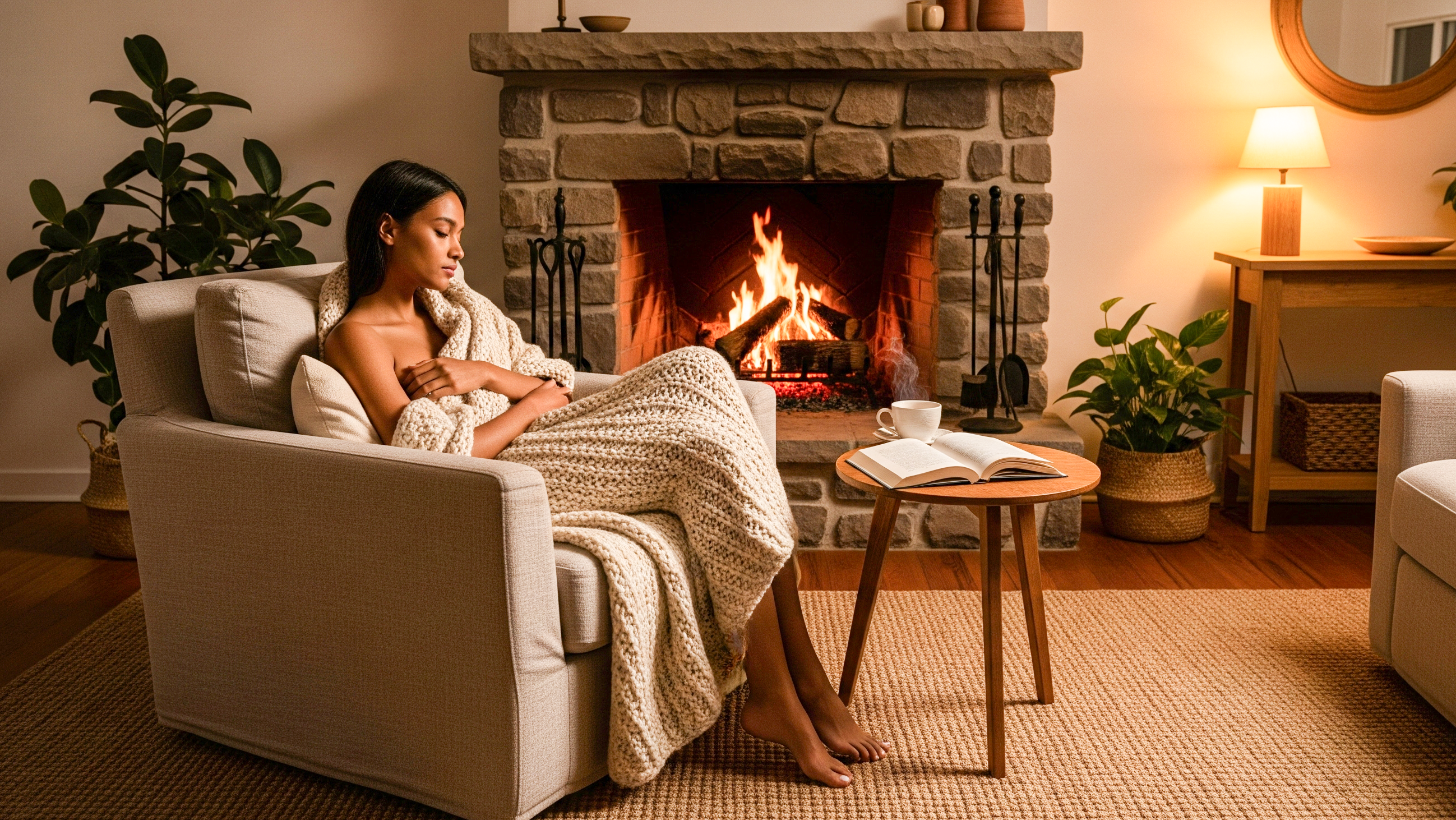
A few years ago, the Danish concept of hygge was popularised. The idea of cosy contentment and hunkering down in a warm room with flames, blankets and subdued lighting can be comforting and a good way to get through the cold, dark months.
Aletheia, a Greek concept, is about a process of revelation. It is not about finding an unchanging truth, but rather about uncovering something that was previously hidden or obscured.
In the context of a cold, dark winter, this could mean a few different things
Uncovering inner truths
The introspective nature of winter, with its shorter days and more time spent indoors, naturally encourages quiet reflection. Hygge, with an emphasis on warmth, soft lighting, and stillness, creates the ideal physical environment for this kind of ‘un-forgetting’. If you consciously create a comfortable, safe space, you are better able to let go of distractions and consider deeper thoughts and feelings that might be buried beneath the busyness of the other seasons.
The truth of a moment
Hygge is fundamentally about being in the moment. This could be as simple as experiencing the warmth of a fire, the taste of a hot drink or the comfort of a blanket. This is a form of aletheia. The truth being uncovered is not a grand philosophical statement, but the simple, profound reality of a specific sensory experience. The cold weather outside serves as a stark contrast that highlights and uncovers the preciousness of the warmth and comfort inside.
Uncovering our nature through human connection
Hygge often involves shared experiences with friends and family. Intimate gatherings around a table or fireplace might lead to people having more open and honest conversations. In this context, aletheia is the uncovering of mutual understanding and the deepening of relationships. The shared experience of being together in a cosy, protected space can allow for a more authentic form of connection to emerge.
Aletheia, biophilia and hygge
I have a professional interest in biophilic design, so this intersection is very more compelling to explore. The choices you can make in creating a hygge-inspired space, such as the materials, the lighting, the arrangement of plants, are not just about aesthetics. They are a deliberate process of uncovering the potential for a space to be a sanctuary. The truth you are revealing is that a human-made environment can be a profound source of well-being and connection to nature, even when the natural world outside is dormant or unwelcoming.
So, where are the intersections and what do they look like?
I think very visually. I like diagrams and I often imagine and describe things as shapes and colours. So, I tried to create a Venn diagram of the relationship between aletheia, hygge and biophilia.
Introspection and self-reflection. Confronting inner thoughts, understanding one’s character, intentions.
Authenticity. Stripping away artifice, being genuine with self and others.
Clarity and insight. Gaining deeper understanding, seeing what’s essential.
Presence. Being fully aware of the current moment and its realities.
Revelation of nature’s cycles. Understanding life, dormancy, resilience.
Truth of human connection. Deepening relationships through shared vulnerability.
Biophilia (love of life and connections with nature)
Sensory coherence. Engaging all senses with natural stimuli (sight, sound, smell, touch).
Natural light and views. Maximizing natural light, connecting to external landscapes.
Natural materials and textures. Incorporating wood, stone, water features.
Plants and greenery. Indoor plants, conservatories, gardens.
Patterns and forms in nature. Fractals, organic shapes, natural rhythms.
Sense of place. Environments that evoke natural settings and processes.
Hygge (cosy contentment and wellbeing)
Warmth and comfort. Soft blankets, cushions, fires, gentle heating.
Atmosphere and ambiance. Soft, layered lighting (candles, lamps), quiet sounds.
Presence and mindfulness. Appreciating simple pleasures, being in the moment.
Social connections. Shared experiences with loved ones, community.
Safety and security. Creating a sanctuary, a protected space.
Simplicity and decluttering. Focusing on what is useful for comfort, without it being distracting.
What happens in the middle?
When you get to the middle of the Venn diagram and look at Aletheia X Biophilia X Hygge, what do we find?
Holistic wellbeing
The combination creates an environment that supports physical comfort, mental clarity, emotional authenticity, and a deep connection to the natural world.
Mindful nature immersion
By creating cosy, nature-rich meditative spaces, you can encourage deep, present-moment reflection and the uncovering of personal and universal truths.
Winter sanctuary for revelation
To get a more complete connection with nature, try and adapt spaces such as a conservatory to offer warmth, natural beauty, and a safe, freeing environment for introspection and genuine connection during the dormant winter months.
Naturism as an extension of hygge
While hygge often focuses on being cosy and wrapped up, nudity presents a compelling alternative perspective. It is a way to achieve a feeling of comfort and contentment by embracing vulnerability and freedom.
Comfort in one’s own skin
Hygge is about creating a space where you feel completely comfortable. For a naturist, this includes being comfortable in one’s own skin. A warm, comfortably-lit living room with natural textures provides the perfect environment for this. To experience a sense of comfort that is not dependent on external layers of clothing, a form of naked hygge.
Simplicity and presence
Both hygge and naturism champion simplicity. Hygge focuses on the simple pleasures of life, and naturism removes the complication and consumerism associated with fashion. This shared emphasis on simplicity makes it easier to be present in the moment and appreciate the authentic truth of an experience.
Naturism as an aletheic experience
When you are in your sanctuary you are not on show. The people you are with (if not enjoying solitude) are those that you are close to and who you choose to be with. Being naked in a biophilic, hygge space allows for the ultimate un-forgetting of societal artifice, fostering body acceptance and a direct, authentic sensory connection to a nature-inspired sanctuary.
Nudity is a powerful, practical extension of both aletheia and hygge. It is a way to achieve the desired state of comfort and wellbeing, not just a lifestyle choice.
The key connection is that naturism is fundamentally about truth and authenticity. Uncovering the body strips away the layers of clothing that can serve as both physical and social barriers.
Uncovering truth
In the context of aletheia, naturism is a profound act of truth telling. It challenges the societal norm that our bodies should be hidden, uncovering a more authentic self-image.
Truth of self
Unclothed, you confront the truth of your own body, without the adornments and artifice of fashion. This can lead to a deeper sense of self-acceptance and body positivity.
Truth of connection
In a social setting, naturism removes a major psychological barrier. Without the social cues and judgments that clothing can impose, people can interact on a more fundamental, human level. This can “uncover” a truer, more egalitarian form of human connection.
Truth of nature
I am not at all religious, nor even spiritual. However, as both a humanist and a biologist, I appreciate the organic and natural world and I am always very conscious that we are an integral part of nature, not just a bystander.
Naturism is a direct way to dissolve the boundary between the person and the natural environment. Being outside in a garden or a natural space without clothing – even for the briefest of time in winter – can create a profound sense of integration and belonging, a physical expression of biophilia. A few minutes of enveloping your body in fresh, crisp air reveals the simple truth that you are a part of nature, not separate from it.
When you combine aletheia, hygge, biophilia and naturism in your home, you are not just creating a cosy space. You are building a sanctuary that actively promotes self-acceptance, authentic connection and a deeper, more truthful relationship with both your body and the natural world.
Moving from the philosophical to the practical – how to create an aletheic hygge space in the home
The living room is the perfect place to start, as it is often the heart of the home and a space for both solitary contemplation and shared connection. Combining aletheia and hygge in a living room means creating an environment that is not just cosy, but also revealing of natural truth and human well-being.
Here are some practical ideas for your living room, broken down into key design principles:
The aletheia of light
Winter can be a time of darkness, but light is a key element of both hygge and aletheia. The truth of the outside world is found in the limited natural light, and aletheia indoors is about a conscious revelation of light in your space.
Let’s start by making the most of what natural light is available. It might be limited, so try and squeeze as much benefit out of it as possible.
Position furniture to take advantage of any natural light coming through windows and use mirrors opposite windows to reflect and amplify the light you do have. This is a subtle yet powerful biophilic principle. Even on a grey day, you are consciously acknowledging and maximizing the natural world outside.
Make use of technology. Smart lighting can be a real boon at this time of year. Intensity and colour temperature can be adjusted, and even automated, to complement the changing conditions outside and if you get it right, the connection between indoors and out can become almost seamless. This not only looks better (as the tone of the light from natural and artificial sources can be matched), but it might reduce eye strain too.
Placing lamps behind objects, such as furniture, so that it washes the wall or ceiling with light rather than being directed into the room can also be calming and is also more naturalistic.
Next, especially in the evenings, consider layered lighting. Instead of using, harsh overhead lighting, use multiple sources, such as table lamps, with warmer toned bulbs. Think about adding a floor lamp near your favourite armchair, a table lamp on a side table, and even a cluster of candles (including the very realistic LED flame versions) on the mantlepiece or a coffee table. The soft, shifting glow of candles is an excellent way to create a warm, calm atmosphere.
The biophilic truth of texture and materials
Our connection to the natural world is fundamental, and biophilic design is all about recreating some of those links in the artificial environments of buildings. This can be expressed through the materials that are used.
Tactile textiles are a good place to start. Layering is key for both visual warmth and physical comfort and for breaking up the harsh shapes created by straight lines and sharp corners.
A chunky knitted woollen throw draped over the sofa, a pile of textured cushions, and a deep pile wool rug would both look and feel warm. Natural colours will add a biophilic touch as well. These textures encourage you to physically engage with the space and feel the comfort. The feelings are definitely amplified and more sensual when naked.
Natural materials that tell a story of their origins are a good way of reconnecting with nature during the cold, damp months of the year. Wooden furniture, a wicker basket for blankets, or a stone or ceramic vase all bring a sense of the outdoors in. The ‘truth’ revealed here is that these elements are not just decorative – they are part of a larger, living system. You might even consider collecting some winter elements from outside, such as logs for the fireplace or a simple arrangement of pinecones and evergreen branches.
Horticultural aletheia: bringing life indoors
In winter, when the garden is dormant, the truth of nature’s persistence can be revealed indoors. Houseplants grouped together can create a mini-ecosystem. Wall mounted planters or moss panels can bring vegetation to eye level. Choose plants that are tolerant of low light levels, and consider a variety of textures and sizes to create a naturalistic look.
As well as house plants, consider some seasonal botanical displays. Cut winter branches, dried grasses, pine cones, seed pods or even a small basket of nuts are all worth considering. The beauty of these elements is in their stripped-back, honest form. They remind us that even in stillness, there is a quiet, powerful life force.
The human truth: hearth and sanctuary
Finally, the living room should be a sanctuary for the human experience. Hygge is about creating a space for this, and aletheia is about the profound truths that can emerge within it. So, it makes sense to be comfortable.
Create a cosy nook with a comfortable armchair and a small table for a book and space for a hot drink or a glass of wine. It’s a place designed for introspection and quiet contemplation, where you can be alone with your thoughts.
If you have a fireplace, it’s the natural heart of the room – a literal hearth. If not, you can create a similar focal point with a well-curated bookshelf, a gallery wall of art, or a collection of cherished objects. These elements tell the truth of your identity and your journey, making the space uniquely your own and a place for genuine self-reflection.
By combining these elements, your living room becomes more than just a place to escape the cold. It becomes a space where the sensory comforts of hygge facilitate the deeper process of aletheia, uncovering the truths of nature, beauty, and your own inner world.
Need some advice?
Get in touch for advice on creating a snug, biophilic and aletheic nook in your home to get through winter.
You may have noticed that I am currently writing this website anonymously. This might seem odd, as one of the points of the site is to discover possible business opportunities and collaborations. So, who am I? Should I reveal myself? Do the benefits outweigh the risks?
Note: This post explores the psychological and wellbeing benefits of naturism within biophilic environments. It contains illustrations depicting nudity and the human form.
You may have noticed that I am currently writing this website anonymously. This might seem odd, as one of the points of the site is to discover possible business opportunities and collaborations. So, who am I?
There is a good reason for my reticence
None of the people that I work with on a day-to-day basis are aware of my interest and participation in naturism. That may not be a problem for many people and (if recent surveys are anything to go by) there is a good chance that many colleagues and customers have taken part in, and may enjoy, naturist activities. Those that I have confided in have been very supportive and understand where I’m coming from.
However, a peculiarity of the interior landscaping and office fit-out industries in the UK is that a very significant proportion of the companies in those sectors (who make up much of my existing, and potential, client base in my day-to-day work) are owned by members of a very conservative religious group. I think that they would have great difficulty in understanding, let alone tolerating, the ideas that I’m trying to develop here.
Let me be clear. These companies are, generally, good employers and their business ethics are, mostly, pretty sound. They have modernised and know that they have to be more accepting of people from backgrounds different from theirs if they want to succeed in business.
I am also fairly sure that the bespoke web browsers that these companies use would block this site, so they would not find it (although those of their employees who are not part of the church might discover it on their private devices and report back).
However, I am pretty sure that some of the concepts behind creating aletheic spaces would be uncomfortable and probably too alien for them to consider working with me again.
Authenticity
You may think that I should be braver and also be authentic. After all, I believe that authenticity is a core tenet of naturism and aletheia is all about revealing the truth. Maybe I should.
Should I risk potential income from one segment of my potential market place to open up new opportunities? Do the benefits of being identifiable outweigh the risks?
Please leave a comment. Your thoughts would be very welcome.
An aletheic environment is a space intentionally designed for unconcealment – stripping away the artificial to create an authentic, unfiltered connection between people and the natural world.
Aletheia is a Greek term for truth or unconcealedness. It is pronounced al-er-thee-ah
In philosophy, Aletheia is one of the primary Greek words for truth. However, its meaning is distinct from a simple fact or statement. It refers to a state of being revealed or unconcealed. Truth, in this sense, is not something you make or construct, but rather something that exists and is brought into the open or un-hidden.
An aletheic space is intentionally unconcealed, authentic, and revealing.
It is a place that strips away the artificial and the inessential to reveal a deeper truth – both about the natural world and about ourselves.
This could mean a space that is designed to help its users reconnect with their natural place in nature. It could also be a place for or being in, or taking part in activities, that can reveal more about our own nature.
Unfiltered connection
Aletheic spaces are where the barriers between the occupant and the natural environment are minimised or eliminated. They are spaces where all of our senses are stimulated to uncover the whole truth about where we are and what we are doing.
For an activity, it could simply be a natural environment where a true connection between the person and their surroundings can be unconcealed. It might be something as simple as taking exercise in nature rather than a gym, meditation in a garden or the practice of forest bathing.
For a building, this could involve incorporating elements of biophilic design. This is where a sense of nature is brought into the built environment by incorporating views of nature, plants and living walls that make the boundaries between inside and outside disappear, soundscapes and scents, or materials in their raw, honest form like exposed wood or stone.
Honesty in design
An aletheic space would be authentic. It would not rely on superficial decoration to appear natural, but would be created with materials that are true to their function and with a design that connects people with nature and and environment.
Most importantly, an aletheic space would be a place where the occupant themselves feels free to be “uncovered” and authentic. It would be a space with an atmosphere of safety, trust, and liberation. A space to become unconcealed and where one’s natural, naked, state is celebrated, allowing for the deepest possible connection to the environment. A space where you stop being an observer of nature and become a part of it.
FAQs
What is biophilia?
A good definition of biophilia is the innate need for humanity to connect with, and be a part of, nature. From an evolutionary point of view, the sense of ease and comfort we get when we are connected with nature can be explained by being in an environment where our senses tell us that we are safe.
What is biophilic design?
Biophilic design is a design principle that is inspired by nature and incorporates natural and naturalistic elements into buildings and the wider built environment with the intention of improving wellbeing. An easy-to-understand (and almost definitive)guide to the principles of biophilic design can be found here.
What is naturism?
Naturism is a way of life in harmony with nature characterised by the practice of communal nudity with the intention of encouraging self-respect, respect for others and for the environment. (INF-FNI definition).
What do you mean by ‘complete immersion in nature?’
Removing the barrier of clothing to our skin offers an unparalleled level of total sensory immersion. It intensifies the connections with nature and our environment. The feeling of air, sunlight, bare earth and the weather directly on the skin promotes a deeper sense of tranquility, mindful awareness, and interconnectedness. This enhances mental restoration beyond the baseline benefits of nature exposure alone.
What is the difference between a biophilic space and an aletheic environment?
Aletheic spaces are where the barriers between the occupant and the natural environment are minimised or eliminated. They are spaces where all of our senses are stimulated to uncover the whole truth about where we are and what we are doing. They can be natural, but where access to nature is limited, they can be designed.
When designed and part of the built environment, they are places for more than just for doing stuff in (or for getting a credit on a checklist), but are places where restoration, sensory coherence and mental clarity can be given every opportunity to occur. It would be a space with an atmosphere of safety, trust and liberation.
Most importantly, an aletheic space would be a place where the occupant themselves feels free to be uncovered and authentic.












Leave a Reply